What are the Different Types of Toilet Paper Making Machines?
If you want to get into the tissue paper business, you should first learn about the different kinds of tools that are out there. There is a wide variety of toilet paper-making machines, from small, entry-level machines called "small toilet paper making machines" to large, fully automatic systems for producing large quantities of paper. Through combined rewinding, perforating, and cutting processes, these conversion tools turn jumbo parent rolls into goods that are ready to sell. The main things that determine the classification are the amount of output, the level of technology, and the amount of capital investment needed. Manufacturers divide machines into three groups: small-scale (less than 3 tonnes per day), medium-scale (3–10 tonnes), and large-scale (more than 10 tonnes). Each group serves a different market area and has different operating goals in the global hygiene goods sector.
Introduction
The business that makes toilet paper is at the center of both customer need and technological progress. Millions of finished rolls of toilet paper arrive at homes and businesses every day, but most people who use this important product can't see the machinery that makes it. Recognizing the various small toilet paper making machines has a direct impact on manufacturing efficiency, cost control, and competitive positioning for B2B procurement managers, plant owners, and distributors.
This guide breaks down the different types of machines into their technical groups, how they work, and the important things you should think about. Whether you're starting a new production plant or adding to one that's already there, knowing how to classify equipment helps you make business decisions that are in line with the market. We'll look at how production size, level of automation, and features of equipment affect procurement strategies. We'll also talk about common problems like high costs, limited room, and the need for expert training.
Overview of Toilet Paper Making Machines
Large-diameter parent rolls are converted into consumer-sized goods by small toilet paper making machines, which are specialized pieces of equipment. The main mechanical process includes a number of functions that work together to do the job: unwinding giant rolls, perforating at specific intervals, embossing for texture, glueing tail ends, cutting to specific sizes, and packing finished logs. Modern systems use hydraulic controls, PLC programming, and varying frequency drives to keep the tension and accuracy constant during production.
Classification by Production Scale and Automation
There are three main ways to classify equipment: daily output capacity, degree of automation, and physical size. Small machines take up less than 100 square meters of floor room and can handle 1.5 to 3 tons per eight-hour shift. Medium-capacity systems can handle 3 to 10 tonnes per day, while industrial-scale lines can handle more than 10 tonnes at once with multiple production stations running. There are different levels of automation, from core loading by hand with cutting managed by an operator to fully automated systems with touchscreens and tension mechanisms that fix themselves.
Key Selection Factors for Procurement
Finding the right tools means balancing a lot of different operating factors. Initial size is often limited by budget, but long-term output goals are just as important. Some designs are limited by the building's electrical capacity (usually 380V three-phase power), roof height for roll handling, and ventilation for dust control. Where you get your raw materials also affects your choices; depending on your supply chain, your machines must be able to handle either virgin pulp specs or recycled fiber characteristics. Following CE and ISO certifications makes sure that equipment meets foreign standards for safety and performance. This is especially important for makers who want to sell their products abroad.
Types of Toilet Paper Making Machines: A Detailed Breakdown
Small-Scale Conversion Units
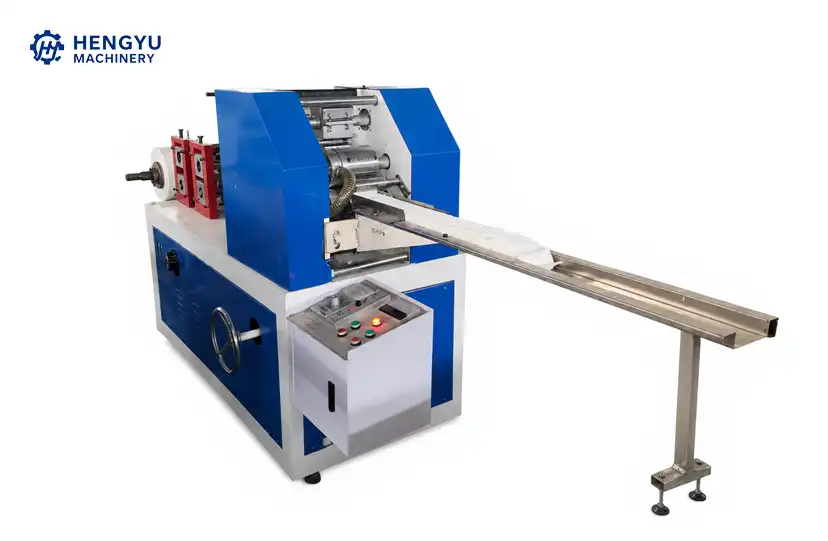
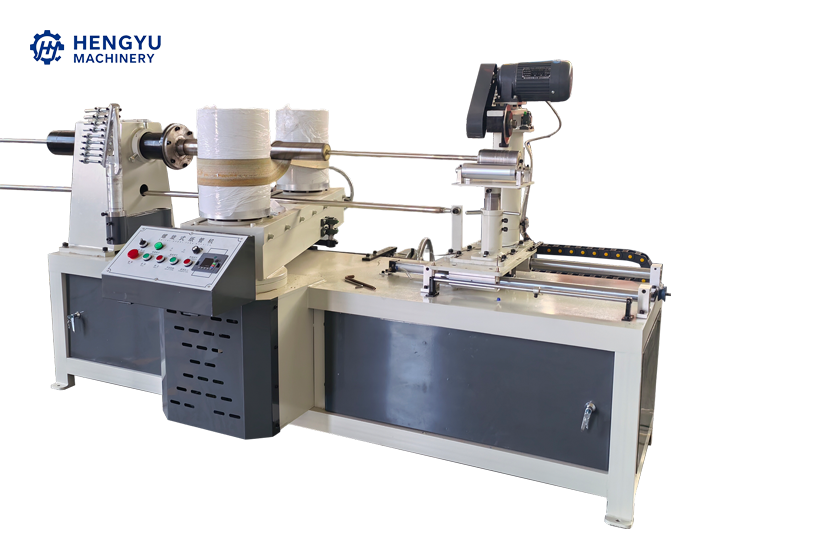
Small businesses and companies that want to start making toilet paper but don't have a lot of money can use compact, small toilet paper making machines. These machines have a single frame that usually measures around 6,200mm x 3,200mm x 1,900mm and can reverse, perforate, and cut all at the same time. The HY-1575 model is a good example of this type of machine because it can handle parent rolls up to φ2200 mm wide and make finished logs with a diameter of 50 mm to 180 mm. With a processing capacity of up to 2.5 tonnes per eight-hour shift and a total power usage of less than 6.5kW, these tools are both easy to use and good for the environment. Before choosing a small-scale unit, procurement teams should look at the needs of their target market, the room they have available in the building, and the skill levels of the operators to make sure they are in line with business goals.
Some of the main benefits are the following:
- Lower Capital Investment: Low prices for entry-level factories make it easier for first-time owners to get the money they need to start up. This lets them get into the market faster without having to borrow a lot of money or form partnerships.
- Simplified Operation: Production staff can become proficient in using manual or semi-automatic settings in days instead of weeks, with little expert training needed.
- Flexible Production Runs: Core sizes (30–55 mm) and perforation lengths can be changed quickly, so different product lines can be made without having to wait for long periods of time.
- Reduced Space Requirements: Less space is needed because the small size fits into normal industrial units or warehouse parts that have been converted, so the facility doesn't have to be expanded, which can be expensive.
These factors make small machines work best in regional markets where the cost of shipping makes local production more desirable than central delivery.
Medium and Large-Scale Industrial Systems
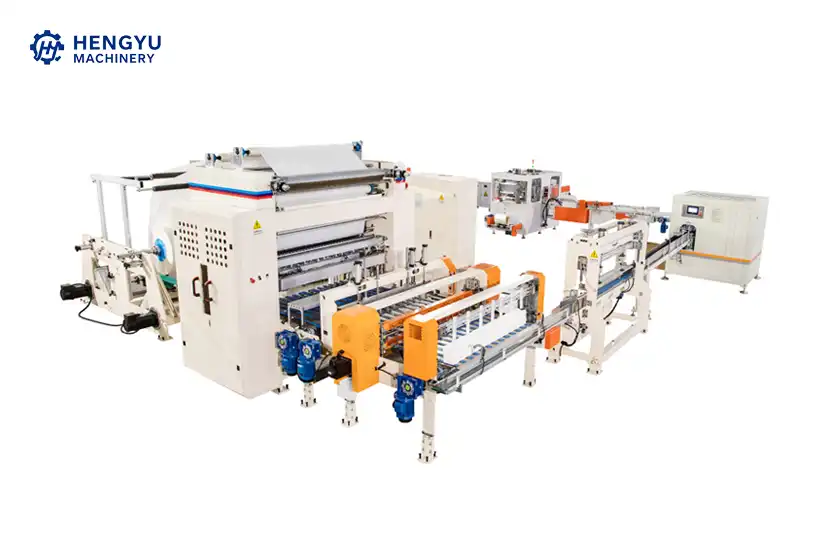
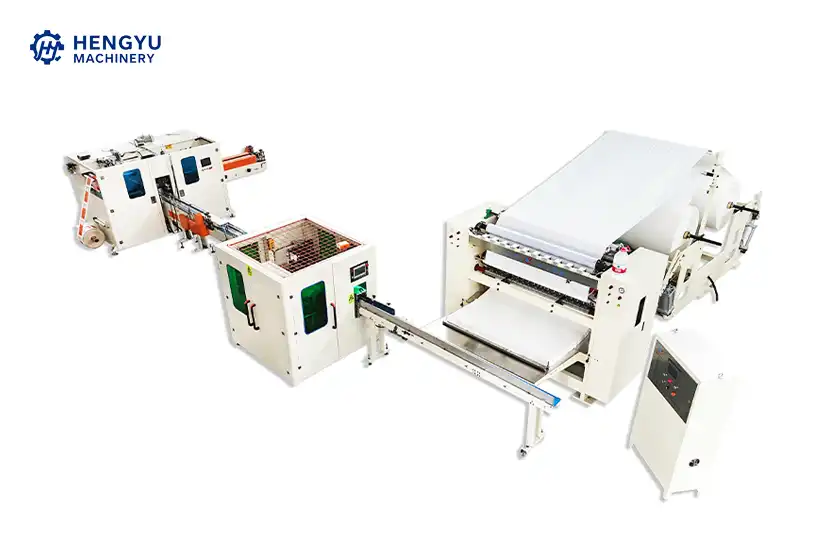
As output goals get bigger, medium- and large-scale systems get more automated and come in more flexible forms. Medium-sized lines usually have two unwinding stations, automatic tension control for several embossing rollers, and band saws built in with air feeds. Large industrial systems might have servo-driven motors for precise speed matching, scrap removal machines that work on their own, and constant production modes that get rid of the need to change rolls by hand.
As the size of the operation grows, so do the output rates. Medium-sized systems can handle 400 to 800 meters per minute of steady ply bonding, while large-scale operations can handle more than 1,000 meters per minute thanks to synchronized multi-station routines. But for this performance to work, the power infrastructure needs to be much stronger (up to 50kW total), it needs to be installed by factory-trained professionals, and it needs to be maintained on a regular basis to avoid costly downtime.
Specialty and Customized Configurations
For some market groups, machines need to be changed in ways that go beyond normal production. Multi-layer embossing tools make high-end three- and four-ply goods for hotel clients who want them to look their best. Perforation designs can be changed to fit the needs of each area. For example, some places like holes that are close together so that the sheets are easier to tear, while others want stronger sheets with perforations that are farther apart. Machines made to process recovered fiber have tension systems that can be changed and cutting blades that are stronger so they can handle different levels of material consistency. OEM and ODM features let makers choose the languages used on the control panels, how their logos are integrated into the machine housing, and the unique dimensions of the outputs that set their products apart in competitive markets.
How Small Toilet Paper Making Machines Work and Operate
Production Workflow and Raw Material Processing
A small toilet paper making machine starts its cycle when a large parent roll is loaded onto the rolling stand, either by hand or with air pressure. The paper goes through a set of tension-controlled rollers that keep the same pull on it the whole time it's being processed. Tear lines can be set at any desired distance between perforating blades, which are usually two movable units placed 100–300 mm apart. Embossing rollers add designs for decoration while pressing and, if desired, applying glue to join multiple plies together.
The continuous web goes through a tail-gluing station where glue sticks the outside of each finished log in place after it has been embossed. After that, a band saw that is powered by air pressure cuts the web into separate rolls with widths that have already been set (50–180 mm). When the logs are done, they fall off a moving belt that leads to stations for packing or temporary storage bins. The whole process moves at the same time, and the variable frequency drives let the workers change the speed of output from 150 to 220 meters per minute depending on the type of paper and the quality goals.
Quality Standards and Output Benchmarks
To get consistent results, you need to make sure that the tension settings, blade sharpness, and embossing pressure are all perfectly calibrated. When small toilet paper making machines are kept in good shape, they can make logs that have a diameter variation of only ±2 mm, perforation alignment accuracy of 98%, and ply bonding stability that can stand up to normal tensile tests. The daily output is usually around 2.5 tonnes when using normal 13–18 GSM tissue types. Denser materials may slow down throughput by 15–20%, though. Energy use stays steady at 5.5kW for main drive systems and 0.75kW for auxiliary functions. This means that operating costs are doable even in places where energy rates are high.
Maintenance Protocols and Operational Efficiency
Routine repair plans have a direct effect on how long machines last and how reliably they produce goods. Every four hours, operators should check the sharpness of the blades and use the built-in grinding devices to fix the cutting edges without taking the machine apart. Bearing housings and pneumatic cylinder seals are oiled once a week with formulas recommended by the maker. Tension roller position and embossing depth uniformity are checked once a month by calibrating the machine. By following these rules, machines will keep working at their stated capacity for the whole time they are in use, which is usually more than five years before they need major component replacement. Compared to reactive repair methods, preventive maintenance cuts unexpected downtime by about 70%, keeping production plans and customer delivery promises.
Comparing Small Toilet Paper Making Machines with Other Types
Production Capacity and Scalability Analysis
Small toilet paper making machines are a good middle ground between fully automated production lines and ways of conversion that are done by hand. A small machine handles 2.5 tonnes of material every day, medium-sized equipment handles 8 tonnes, and big systems handle more than 20 tonnes per shift. This difference in capacity shows not only differences in speed but also differences in operational complexity. Small machines can be supervised by a single operator, but bigger systems need specific teams to manage multiple production stages at the same time.
Scalability concerns go beyond just getting results right away. Startups that start out with small amounts of equipment can test the market and make product recipes better before spending a lot of money on bigger pieces of equipment. Adding a second small machine to double capacity is a modular way to grow without replacing all of the equipment. This keeps the original investments safe while increasing the production area. This flexibility is especially helpful in developing countries, where it's harder to predict what people will want.
Cost-Efficiency and Return on Investment
The initial costs of buying something are only one part of the total costs of owning. Small machines require less up-front capital—usually one-third the investment of medium-sized machines—but they also use less power and take up less space in the building. Operating costs, which include labor, repair supplies, and energy, are usually 30–40% lower than the same amount of work done by bigger machines that aren't working at full capacity.
To figure out ROI, you have to look at how the product is positioned in the market and how much it costs. Small-scale equipment often pays for itself faster for manufacturers that cater to narrow markets with high-end three-ply products or custom packing because they can make more money off of the lower volume. On the other hand, makers of commodity tissue that want to sell to a lot of people gain from large-scale efficiency, even though it takes longer to recover capital. To get a good ROI estimate, you need to match the skills of your tools with specific market possibilities instead of using general industry standards.
Environmental Compliance and Sustainability
Regulatory standards are having a bigger impact on the choice of tools, especially for companies that sell their goods in Europe and North America. Small toilet paper-making machines that have CE approval show that they meet safety standards for electricity, noise, and motor guarding. Using ISO 9001 quality management systems makes sure that production methods are always the same and that waste and mistakes are kept to a minimum.
Features that save energy, like variable frequency drives, use less power when not in use or when running at low speeds, which helps reduce carbon emissions. Machines made to process recovered paper support efforts to create a circular economy, but they need better dust collection systems to handle fiber particles. Sustainability credentials are appealing to business-to-business buyers who work with eco-friendly shopping platforms. They create a competitive advantage beyond price and capacity measures.
Where and How to Procure Small Toilet Paper Making Machines
Identifying Reliable Manufacturers and Suppliers
There are many makers in the global tissue machinery market, but the dependability of suppliers varies a lot. Established manufacturers who have been in business for decades usually offer better customer service after the sale, well-organized stocks of spare parts, and proven fitting skills. When purchasing teams look at possible suppliers, they should check the certifications of the production facilities, read customer reviews from similar market groups, and ask for detailed technical specs that go beyond the generalities in marketing literature.
Henan Hengyu Machinery Co., Ltd. is an example of a well-known company that makes tools for changing tissues. They've been in the business for more than 20 years and offer full production line options, such as rewinding machines, cutting systems, and packing tools, so factory startups can get everything they need right away. Their research and development (R&D) helps OEMs and ODMs make changes to machines so they meet the needs of different markets in terms of power standards, control panel languages, and size requirements.
Procurement Process and Due Diligence
Getting tools works best when you follow organized steps that lower the risks of buying. When making the first inquiry, you should ask for detailed technical information about the machine, such as its specs, power needs, installation footprint, and suggested extra parts stock. Suppliers with a good reputation let buyers watch production runs before they are shipped, which lets them compare performance claims to contractual standards.
Finance choices depend on the buyer's credit history and contact with the supplier. Some makers offer payment terms that are spread out over time or lease agreements for tools that help keep working capital high while production ramps up. The warranty usually lasts for twelve months from the date of installation approval, but additional service agreements protect against component failures for longer periods of time. Transportation plans need to be carefully coordinated. Shipping in containers works for most small machines, but fragile parts like embossing rollers need special handling and crating methods.
Post-Purchase Support and Technical Service
Delivering equipment is more like the start of a relationship with a seller than the end. Installation services by factory-trained experts make sure that the mechanical parts are put together correctly, that the electrical connections meet local rules, and that the pneumatic system is set up and running. Operational training programs teach production staff how to use control interfaces, make regular changes, and fix problems in a way that doesn't require calling outside service.
As factory operations get more experienced, production stays steady thanks to ongoing technical help like remote diagnostics, video consults, and faster shipping of extra parts. When urgent repair needs come up, suppliers with regional service centers or authorized dealer networks can handle them faster than those who need to send technicians all over the world. Lifetime technical support promises, which are becoming more popular among high-end makers, give customers peace of mind that their investments in equipment will be protected for as long as they are used.
Conclusion
Small toilet paper making machines come in a wide variety of designs, each one made for a different production level, level of automation, or market placement. Small-scale conversion units make it easy for startups and small businesses to get started. They have small areas but enough capacity to serve regional markets successfully. Medium- and large-scale systems can meet higher volume needs with advanced robotics and modular production stages, but they need a lot more money and expert help. Unique needs, like making quality multi-ply products or handling recycled fiber, can be met by specialty tools, which shows that the industry is always coming up with new ideas. A successful procurement depends on matching the capabilities of the tools with accurate assessments of the market, the limitations of the building, and the long-term business goals. Manufacturers can make smart investment choices that support long-term growth in the competitive tissue products sector by knowing these basic levels of classification and operational traits.
FAQ
What distinguishes small toilet paper-making machines from industrial-scale equipment?
Small toilet paper making machines focus on being small, having simple controls, and needing less cash. This makes them good for new businesses that need to handle less than 3 tons of material every day. Industrial systems have more technology, can make things faster (more than 1,000 meters per minute), and have quality control built in, but they need much bigger buildings and highly trained technicians.
Can small-scale machines process both virgin and recycled paper grades?
Yes, tension control devices can work with different types of materials. Recycled fiber processing, on the other hand, needs slightly slower speeds and better dust collection to keep the cutting blades lasting longer and the ply bonds stable.
What maintenance schedule ensures optimal machine performance?
Every four hours of operation, the blade is checked and sharpened as needed. Lubricating bearings and air parts once a week keeps them from wearing out too quickly. Regular monthly calibration checks make sure that the tension rollers are aligned correctly and that the stamping depth is always the same. This cuts down on unplanned downtime by about 70%.
How do power requirements affect facility planning?
Most small tools need 380V three-phase power that uses between 5.5 and 6.5 kW total. Before installation, facilities must check the electrical infrastructure's capacity, make sure it is properly grounded for safety reasons, and make sure there is enough circuit protection.
Ready to Launch Your Tissue Production Operation?
With our complete machinery solutions, HENGYU has helped producers in the Middle East, Africa, Southeast Asia, and other places set up profitable tissue production plants. Our HY-1575 Small Toilet Paper Making Machine can make 2.5 tonnes of toilet paper every day. It has adjustable cutting, automatic core feeding, and energy-efficient operation, and it has CE and ISO standards to back it up. Our experienced team offers custom ODM/OEM designs, installation training, and lifetime technical support, whether you're a startup investor looking for turnkey systems or a well-known maker looking to increase capacity. Get in touch with our experts right away at doris@hytissuemachine.com to talk about your production goals and get a full analysis of the small toilet paper making machine supplier choices that fit your budget and the needs of your market.
References
1. International Tissue Industry Review: "Global Trends in Tissue Converting Technology and Market Dynamics," Annual Publication 2023.
2. Chen, L. & Rodriguez, M. "Energy Efficiency Standards in Small-Scale Paper Converting Equipment," Journal of Industrial Manufacturing Technology, Vol. 45, 2022.
3. European Tissue Symposium: "Sustainability and Automation in Modern Tissue Production," Conference Proceedings 2023.
4. American Pulp and Paper Association: "Technical Guidelines for Tissue Machine Selection and Procurement," Industry Standards Manual 2024.
5. Patel, R. "Cost-Benefit Analysis of Tissue Converting Equipment Across Production Scales," Manufacturing Economics Quarterly, Spring 2023.
6. Global Hygiene Products Manufacturing: "Emerging Markets and Localized Production Strategies," Market Research Report 2024.
_1786963242593.webp)
_1786504312779.webp)
_1786962247965.webp)
_1787014134538.webp)
_1787294187070.webp)
_1784082301486.webp)