Toilet Paper Rewinder Machine Price, Working Principle and Complete Buying Guide
A tissue converting line lives or dies by the precision of its rewinding stage. A high-performance toilet paper rewinder machine unwinds a jumbo parent roll, applies embossing and perforation, glues and seals the tail, then delivers a dimensionally consistent log ready for the log saw — all in a continuous, high-speed cycle. This guide covers working principles, machine typology, cost drivers, procurement criteria, and maintenance best practices, giving technical directors and procurement teams a single reference point before committing capital to a major line upgrade.
How a Tissue Rewinder Actually Works
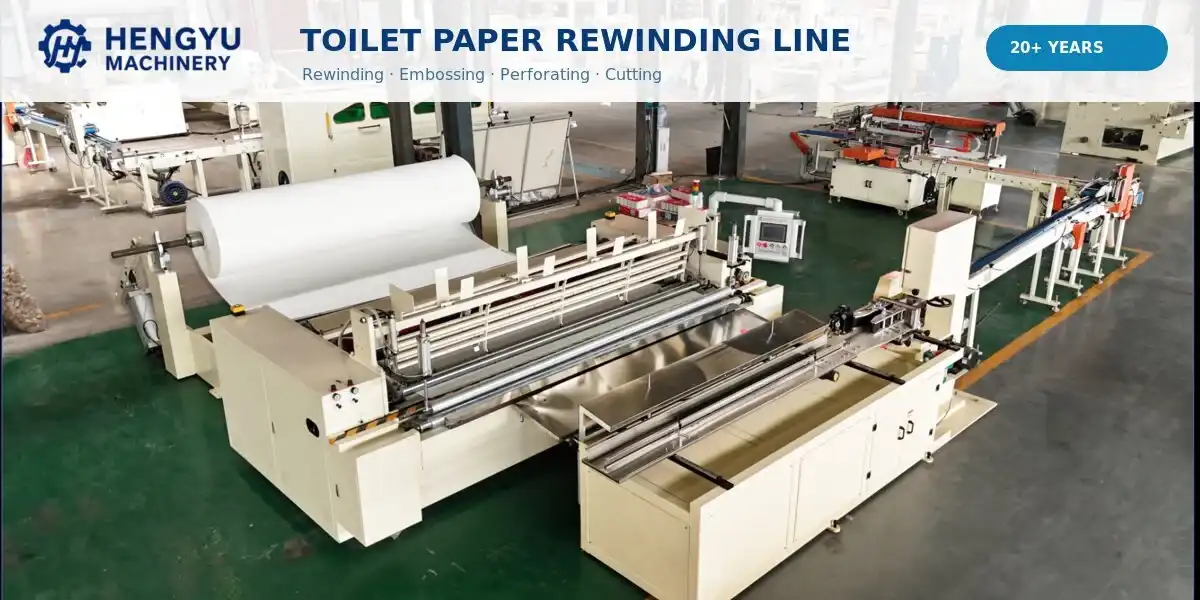
At its core, a toilet paper rewinder machine is a system for managing tension in a closed loop. The parent roll, which can be up to 1200 mm in diameter and 2200 mm wide on the Hengyu HY-1575, feeds through a dancer-roller unwind stand that keeps the web tension the same even as the roll diameter decreases. The web then goes through the embossing nip, where a 240 mm steel-wool or steel-rubber roll adds a three-dimensional pattern that makes the fabric seem thicker and softer. A helical perforation unit with three surface knives cuts the web at a standard 110 mm pitch, but this can be changed up or down to ±2 mm. A small amount of glue is put on the tail by the PLC-synchronized gluing module, and a 32–50 mm core tube is put in by air core loading before winding starts.
PLC and Tension Control
You can use either a Delta or a Siemens PLC to coordinate speed references between the sections that unwind, emboss, perforate, and wind. Each axis has frequency-conversion drives that stop mechanical shocks when the rolls are changed. This keeps delicate tissue webs as light as 12 g/m² safe. Touch-screen displays let operators change the diameter of the winding (Ø70–180 mm standard, up to 350 mm for custom configurations) and the length of the log without having to stop the line.
Safety Architecture
As standard, there is an emergency stop response, pneumatic braking on the unwind mandrel, and interlocked guarding on the perforation section. The control reliability of these circuits is governed by ISO 13849 safety categories. This makes sure that the line meets the CE export requirements for Europe and the Middle East.
Types of Rewinding Machines and How They Compare
Over- or under-specification can be very expensive, so make sure you know where each machine type fits in with your output goals.
Fully automatic lines, like the HY-1575, enter cores, thread webs, glue, and remove logs all without any help from an operator. They can move up to 220 m/min and are good for companies that work 24 hours a day and process more than 50,000 tons of material a year. Semi-automatic lines cost less up front but need more work per shift because the cores and tails have to be loaded and sealed by hand. Manual toilet paper rewinder machines should only be used for test runs or small-scale boutique output.
It is just as important to tell the difference between slitting machines and toilet paper rewinder machines. A slitter cuts a wide jumbo roll into mill rolls that are smaller, and a rewinder turns those narrower rolls into finished customer logs. If you buy a slitter when you need a rewinder, or the other way around, you'll be late on your return on investment (ROI) by months.
Coreless Roll Capability
The HY-1575 has a special coreless winding device that is controlled by a PLC and pneumatics. Coreless toilet paper rolls are popular in high-end stores in North America and Europe because they cut down on cardboard waste and make it possible to pack pallets more tightly. If your target market includes eco-label retail shelves or hotel amenity programs, making sure the equipment has coreless capability before you buy will save you a lot of money in the long run.
Price Guide and Total Cost of Ownership
The price of a toilet paper rewinder machine depends on its web width, speed class, automation level, and PLC brand. Instead of giving a single number, which changes based on the price of steel, where parts are sourced, and how they are shipped, experienced procurement managers look at the overall cost of ownership in four areas:
- Capital equipment: The computer, the embossing unit, the perforation section, and the PLC cabinet. Costs for tooling and structural steel are higher for wider web widths (2200 mm vs. 1575 mm) and faster speeds.
- Integration costs: Putting together a downstream pair with a log saw and the HY-4424A wrapper costs more for civil engineering, installation, and testing. With dimensions of 8800 mm × 3400 mm × 1800 mm, the HY-1575 needs a production bay of about 1500–2000 m² to fit the whole line.
- Consumables and spare parts: Every 500 hours of use, perforation blades wear out and need to be replaced. An deal to store spare parts locally that was already discussed cuts down on the cost of emergency air freight. At the quotation stage, Hengyu gives a written list of spare parts.
- After-sales and warranty: Hengyu offers a standard 1-year quality guarantee that covers both mechanical and electrical problems. With remote diagnostics through PLC data export, engineers don't have to come to the site as often, which lowers the cost of service over time.
When compared to Italian competitors like Baumer and Recard, Hengyu's HY-1575 aims for a more accessible price range while maintaining the most important technical specs (220 m/min speed, 2200 mm width, CE and ISO compliance).
How to Choose the Right Machine: A B2B Buying Framework
Specification mistakes that raise capital costs or limit future capacity can be avoided with a planned review.
As a first step, engineering and buying teams should agree on the following key factors before sending out a technical RFQ for a toilet paper rewinder machine:
- Web width and parent roll diameter: Make sure you know what the standard sizes are for your jumbo roll supplier. It can handle rolls up to 2200 mm wide and 1200 mm in diameter, which means it can work with almost all commercial tissue mills.
- Finished roll specification: Standard roll diameter is 76.2 mm, but can be made to fit any size up to 350 mm; core ID is 32–50 mm; coreless option is also available.
- Speed and shift pattern: The intended speed of 220 m/min allows for constant three-shift operation. Make sure that your electricity system can handle a total of 13 kW of use (7.5 kW plus 5.5 kW) without the power dropping.
- Embossing configuration: Different types of markets are served by steel-wool, steel-rubber, and gluing systems. Deep-emboss steel-to-steel patterns are preferred by high-end hotel supply chains, while throughput is more important to low-cost retail channels.
- Compliance requirements: All goods coming into the EU or GCC must have a CE mark on them. Kenya and a number of other Sub-Saharan markets need PVOC certification. Check the paperwork from the seller before you sign it.
- Vendor evaluation: When evaluating a vendor, you should ask for a video review of the plant, contact information for past customers, and a pre-shipment acceptance test. As usual, Hengyu lets customers take video trips of the factory and visit the plant.
When these factors are carefully looked at, the group of suppliers is cut down from dozens to just two or three good ones. This speeds up the final negotiation cycle.
Maximizing Efficiency and Machine Longevity
A line that is running at 85% overall equipment effectiveness (OEE) does better than a line that is running at 70% OEE, even though the latter should be faster. For a toilet paper rewinder machine line to have a high OEE, it needs trained workers and regular preventative maintenance.
Every 250 hours of use, grease the bearings on the winding shaft and the journals on the embossing roll. Check the helical perforation blades every 500 hours and change the anvil blade set before the difference in size goes over ±2 mm. Every month, make sure the tail-gluing spray nozzle is calibrated so that adhesive doesn't build up and contaminate the web or cause logs to stick downstream.
Operator training is worth a lot more than what it costs. For a trained user, changing the winding width, perforation pitch, and log length through a touch screen only takes less than two minutes. Hengyu says that more than 95% of customers finish installation and initial setup with the help of remote video coaching. This cuts the time it takes to start production by a large amount.
A medium-sized tissue company in Southeast Asia switched from a semi-automatic line that was 1575 mm wide to a fully automatic 2200 mm Hengyu line. Within the first six months, they saw a 38% drop in the cost of labor per ton, and trim waste dropped from 4.2% to 1.8% because of more accurate tension control.
Conclusion
Choosing a toilet paper rewinder machine tissue rewinding line is a complex engineering and financial decision that takes serious industrial buyers six to twelve months to make. The HY-1575 is designed to meet the needs of the most demanding customers in that market. It has a web width of 2200 mm, a speed of 220 m/min, the ability to work without a core, CE/ISO compliance, and PLC-based remote diagnostics. The right measure is total cost of ownership, not sticker price. When you add in a supplier who offers video inspections before shipping, written agreements for spare parts, and on-site commissioning engineers, the payback calculation becomes a lot more accurate.
FAQ
How long does a rewinding machine typically last?
A well-built industrial toilet paper rewinder machine will work effectively for 10 to 15 years with regular preventive maintenance like replacing the blades, greasing the bearings, and checking the electricity once a year. The HY-1575's frequency-conversion drives and wall-panel mainframe are made to work with three-shift duty cycles all the time.
Can the machine handle different paper grades and roll diameters?
Yes. The adjustable frequency drives and closed-loop tension system make up for the differences in tensile strength between virgin pulp (higher GSM) and recycled fiber (lower tear resistance). The finished roll's width can be changed using a touch screen from Ø70 mm to Ø350 mm.
What after-sales support does Hengyu provide?
Hengyu offers a mechanical and electrical guarantee that lasts for one year, a written list of spare parts that can be stored locally, remote PLC diagnostic help, and sending a tech to the site to set up the system. Long-term arrangements for spare parts can help keep upkeep budgets stable after the warranty period is over.
Is CE certification included?
Yes. The HY-1575 comes with both CE and ISO standards. PVOC paperwork is available on request for markets that need it.
Request a Quote from HENGYU — Trusted Toilet Paper Rewinder Machine Manufacturer
With more than 20 years of building knowledge and global shipping support, HENGYU offers full tissue converting lines that include a toilet paper rewinder machine, a log saw, and a wrapper. Contact our technical team for a custom configuration, FOB/CIF quote, and video factory inspection plan, whether you are upgrading an existing line or planning a new one. To start your technical question right away, email doris@hytissuemachine.com or visit hytissuemachine.com to start your technical inquiry today.
References
1. TAPPI — Tissue Manufacturing Technology: Converting and Finishing Processes, TAPPI Press, 2019.
2. Paper Technology International — "High-Speed Rewinding: Tension Control Advances in Tissue Converting," Vol. 58, 2021.
3. ISO — ISO 13849-1: Safety of Machinery — Safety-Related Parts of Control Systems, International Organization for Standardization, 2015.
4. Confederation of European Paper Industries (CEPI) — Key Statistics: European Pulp and Paper Industry, CEPI Annual Report, 2022.
5. Pulp & Paper Canada — "OEE Benchmarking in Tissue Converting Operations," Vol. 119, 2020.
6. RISI (now Fisher International) — Global Tissue Market Outlook: Capacity, Demand and Technology Trends, Fisher International, 2023.
_1787294187070.webp)
_1784082301486.webp)