Facial Tissue Production Line: Functions and Advantages
A facial tissue machine is the backbone of any modern tissue converting operation. It transforms jumbo parent rolls into precisely folded, market-ready sheets through a sequence of automated stages — feeding, embossing, folding, cutting, and stacking. For private label manufacturers serving retail chains and hotel groups, the right production line determines not just output volume, but brand reputation. This guide breaks down how these systems work, what to look for when comparing options, and why investing in a fully automated line is one of the most strategic moves a mid-sized tissue manufacturer can make.
Overview of the Facial Tissue Production Line
A facial tissue machine production line is made up of more than one machine. Each part of the system—the unwind stand, the embossing rollers, the interfolding unit, the cutting station, and the stacked conveyor—has to work perfectly with the others. The final product's quality depends just as much on how well these parts talk to each other as on how well they are made.
Automatic vs. Semi-Automatic: What the Difference Means in Practice
Fully automatic lines control the tension, change the speed, and find faults without any help from a person. In semi-automatic setups, roll changes and stacking have to be done by hand by workers. Fully automated production is not a nice-to-have for a plant that makes many private label SKUs every day; it's a must for staying competitive. In high-speed settings, mistakes made by hand can cause a lot of downtime, which is why leading OEM manufacturers prefer PLC-driven systems to older mechanical ones.
Key Components at a Glance
There are some fundamental parts that all high-performance tissue conversion lines have in common:
- Unwind and tension system — Handles jumbo rolls with a diameter of up to 1,500 mm, and pneumatic braking stops paper of different GSM grades from breaking.
- Embossing unit — Steel-to-steel rollers create texture designs that make the product more absorbent and more attractive to look at, which is a key way for quality private name goods to stand out.
- Interfolding and folding mechanism — Vacuum-assisted folding boards can make V-fold, N-fold, or Z-fold shapes that are the same size on every sheet.
- Cutting and stacking station — Servo-driven blades cut sheets to the right length and then stack them in the right number of stacks for further packing.
All of these parts work together to make the facial tissue machine line offer consistent quality on a large scale, which is exactly what buyers from supermarkets and hotels look for during plant audits.
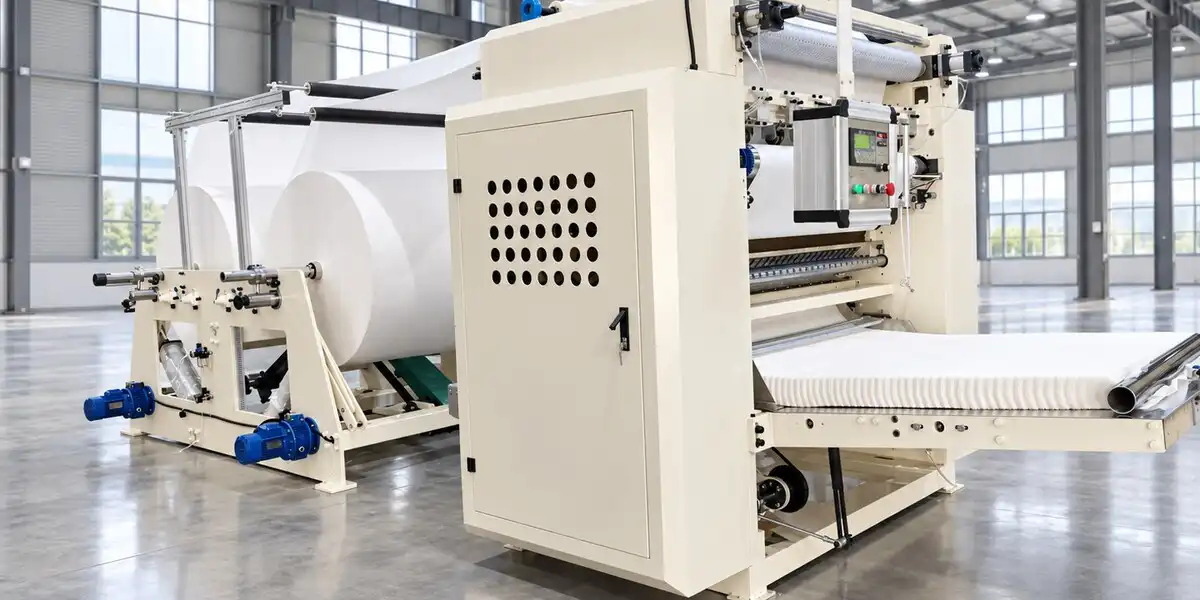
How Does a Facial Tissue Machine Work?
The first step is the unwind station, where the parent roll is fed into the line while the tension is controlled. After going through the embossing unit, steel-to-steel rollers press down on the paper to give it a textured surface. The web then goes into the folding section, where vacuum suction pulls individual sheets into the interfolding mechanism, which is the most important part of any tissue-converting system.
The Role of the Vacuum System in Folding Accuracy
The Roots 15 kW vacuum pump in the HENGYU HYF-1050 is not an extra part. It keeps the negative pressure constant across the folding blades, which makes sure that each sheet fits into the next at just the right spot. Even small changes in suction pressure can cause folds to be out of place, which leads to packaging jams and waste when the production speed is close to 1,000 sheets per minute. So, controlling the waste rate is directly related to having a strong vacuum system. Private label makers pay close attention to this measure because rejected sheets cut into their profit on fixed-price contracts.
Maintenance Cadence That Protects Uptime
Depending on whether they use recycled or new wood pulp, operators should check the cutting blades every 500 to 800 production hours. Embossing rollers need to be cleaned every so often to keep fibers from building up and making the embossing pattern less clear. To keep the pressure steady, vacuum brushes need to be replaced on a regular basis. Adding these checks to a structured maintenance calendar cuts down on unplanned stops by a large amount.
Comparing Facial Tissue Machines: Making the Right Choice
When picking between machine configurations, you have to think about the level of automation, the output capacity, the amount of energy used, and the speed of the changeover. There are some mechanical similarities between facial tissue machines and napkin machines, but the folding geometry and sheet size are very different. You can't use a napkin line to make facial tissue; it's not an option.
Here are the core parameters that differentiate equipment tiers for a mid-sized OEM manufacturer:
- Production speed — Most entry-level machines can handle 300 to 500 sheets per minute. Models with a high speed, like the HYF-1050, can print 1,000 sheets per minute, which makes large private label runs much cheaper per sheet.
- Changeover capability — For companies that work with a lot of different stores, being able to quickly switch between embossing designs and sheet sizes is very important. Changeover time is cut down by a large amount on machines with tool-free control systems and clearly mapped HMI settings.
- Energy footprint — The HYF-1050 runs on 4 kW of main power plus the 15 kW vacuum pump. Knowing the total amount of power used helps production managers figure out how much it costs to run the plant and avoid surprises during capacity checks.
These distinctions matter most when a factory's business depends on being flexible—taking orders from different brands with different requirements and short lead times.
Benefits of Investing in Automated Facial Tissue Production Lines
Moving from semi-automatic to fully automated tissue conversion brings clear benefits in a number of areas. As speed control and fault reaction are taken over by PLC systems, workers are less needed. The consistency of the sheets gets better because machine logic gets rid of the differences that come from making changes by hand. And for private label makers in particular, being able to make sure that every batch of their products is of the same high quality makes their reputation with store buyers stronger.
Here are the core advantages that automated facial tissue machine lines provide to OEM manufacturers:
- Consistent emboss quality — Steel-to-steel embossing gives the whole working area of 1,050 mm the same depth and pattern sharpness. This lets makers sell a higher-quality product at a higher price.
- Reduced waste rate — PLC systems that are properly calibrated and steady vacuum suction keep waste below 2%, which is important when output amounts are high.
- Scalable output — Variable frequency drives let workers run the line at a slower speed during tests and then speed it up to full capacity once the parameters are checked. This keeps paper stocks safe during changeovers.
- Safer working environment — Automated screening and touch-screen problem alerts make the workplace safer by limiting the operator's contact with fast-moving mechanical parts.
These benefits directly lead to the kind of factory audit performance that gets and keeps private label contracts with big grocery and hotel chains.
Procurement Guide: Buying and Maintaining Your Tissue Converting Equipment
When looking for capital equipment on international markets, you need to look at more than just the machine's specs. It's also important to have a reliable after-sales system, easy access to parts, and clear guarantee terms. This is especially true for companies in the Middle East, Southeast Asia, and Africa, where there may not be many local service networks for specialized machinery.
What to Evaluate Before Committing to a Supplier
Before making a purchase, buyers should ask for video demonstrations at production speed. Live video inspection of the factory from afar has become a standard step before shipping. Some important warranty terms to make sure you understand are how long parts are covered, how fast expert help is provided, and whether remote PLC checks are included. The HENGYU HYF-1050 comes with a one-year warranty that covers any non-human-damaged parts and covers free replacements. It also comes with lifetime technical support and online help that is available 24/7.
Installation, Training, and Ramp-Up
Over 95% of HENGYU customers finish the installation with help from a distance, using clear video walkthroughs and direct touch with an engineer. Installation can also be done on-site. The training for operators includes how to use the HMI, set the speed, change the embossing roller, and do regular maintenance. After installation, most factories reach stable batch production in the first week.
Conclusion
Private label companies need a well-designed facial tissue machine line to be able to serve demanding brand clients quickly, consistently, and with ease of changeover. The important thing is to make sure that the machine's capabilities match your actual production mix. You should think about things like sheet formats, embossing needs, and how often your order book needs to switch SKUs. Not only is it a production choice to buy a high-speed, PLC-controlled system with a solid vacuum infrastructure. It's a business issue that has a direct effect on your ability to get and keep contracts.
FAQ
What is the difference between a facial tissue machine and a napkin machine?
Facial tissue machines use interfolding mechanisms, which are usually V-fold or N-fold, to make sheets that come out one at a time. Different napkin tools are best for open-fold or quarter-fold forms and use different folding geometry. When it comes to production, the two types of machines can't be switched out.
How often should cutting blades be serviced?
How often you check the blade depends on the type of paper. Because new wood pulp is less rough than recycled stock, blades that process new wood pulp can usually go 700–800 hours without needing to be inspected. That time is cut shorter by recycled paper. Having a spare set of blades on hand cuts down on downtime while replacements are being made.
Can the machine produce multiple folding styles?
The HYF-1050 works with V-fold, N-fold, and other interfolded forms that are similar. To change setups, you have to make changes to the folding boards and the HMI to update the settings. The tech team at HENGYU gives advice on how to switch between formats.
Is the finished sheet size fixed?
No. The standard output is 200 mm wide and 100 mm folded, but the width and length can be changed to meet the needs of a private label. During the technical consultation stage before production, the custom sizes are confirmed.
Get Your Custom Tissue Converting Solution from HENGYU
For more than 20 years, HENGYU has helped tissue makers in the Middle East, Southeast Asia, and Africa. Our team can set up the right solution based on your actual order mix, whether you are expanding a private label business that you already have or creating a new line of facial tissue. Contact our specialists directly at doris@hytissuemachine.com or visit hytissuemachine.com to request a product demonstration or customized quotation for your facial tissue machine supplier requirements.
References
1. TAPPI — Tissue Technology and Converting Equipment Standards, TAPPI Journal, 2022.
2. Food and Agriculture Organization of the United Nations — Pulp and Paper Capacities Survey, FAO, 2023.
3. Smithers Pira — The Future of Tissue to 2027, Smithers, 2022.
4. RISI/Fisher International — Global Tissue Market Report, Fisher International, 2023.
5. ISO — ISO 9001:2015 Quality Management Systems — Requirements, International Organization for Standardization, 2015.
6. European Tissue Symposium — Sustainability and Efficiency in Tissue Manufacturing, ETS Industry Report, 2023.
_1787294187070.webp)
_1784082301486.webp)