How Does a Tissue Roll Making Machine Improve Production Efficiency?
A tissue roll making tissue roll making machine directly improves production efficiency by automating the full converting process — from jumbo roll unwinding through perforation, gluing, rewinding, cutting, and packing — within a single integrated line. By replacing manual steps with PLC-controlled automation, manufacturers achieve consistent output quality, faster changeover between product specifications, and significantly reduced labor dependency. For OEM factories handling multiple brand orders, this means higher daily throughput, fewer quality rejections, and the production consistency that brand customers demand during factory audits.
Understanding Production Efficiency in Tissue Roll Manufacturing
You should know what "production efficiency" means on the factory floor before you buy new equipment for converting.
Defining Key Performance Indicators
Three main KPIs are used to measure how efficiently tissue is being converted: output speed (meters per minute), daily amount, and machine uptime percentage. A line going at 280 m/min with few breaks always does better than a faster machine that has to stop a lot for paper breaks or changeovers.
Where Traditional Lines Lose Ground
In older semi-automatic systems, the jumbo rolls have to be loaded by hand, the paper cores have to be fed by hand, and the glue has to be applied by hand. Each human touchpoint adds a level of uncertainty. When different brand specifications are run on the same line every week in an OEM setting, these differences add up to quality problems that brand customers notice during inspections.
The Real Cost of Downtime
Unplanned stops can lower line usage by 15–25% in mid-sized converting plants, according to data from the Paper and Packaging Board or the industry. For a factory that processes 3–3.5 tons per shift, even a 10% drop in efficiency means missed delivery windows, which is a big problem when it comes to meeting OEM orders that need to be done quickly.
Key Features of Tissue Roll Making Machines That Boost Efficiency
A basic tissue roll making machine and a high-output conversion line are different in how they work and how they are controlled. These are the main features of this kind of tools that make it more efficient.
- PLC control with stored product recipes: The PLC system on HENGYU's line stores multiple format parameters. Operators switch between brand specifications by recalling a saved recipe rather than manually readjusting each component. This reduces format changeover time from hours to minutes — critical for OEM factories managing several brand clients simultaneously.
- Automatic pneumatic paper loading with three jumbo roll stands: When one jumbo roll is exhausted, the system switches to the next stand automatically without stopping the line. This continuous-feed design eliminates the production gap that occurs each time operators manually load a new parent roll, directly increasing uptime per shift.
- Automatic paper core feeding system: Paper tubes feed continuously to the rewinding station in sync with the winding cycle. Without this feature, core feeding becomes a pacing constraint that caps production speed regardless of how fast the rewinding mechanism runs.
- Synchronous belt transmission: The synchronous belt coordinates all drive components, preventing tension variation between the unwinding and rewinding stations. Consistent tension means fewer paper breaks and uniform winding density across every finished log — a quality consistency requirement that brand auditors frequently check.
All four of these things work together as a whole. The most value is added to an OEM factory when all four work together instead of separately. When put together properly, they get rid of the main sources of waste that affect both daily output and the regularity of the finished product.
Optimization Techniques to Maximize Machine Performance
Hardware alone doesn't mean that it will work well. Whether the equipment keeps working the way it should over time depends on how the plant runs and takes care of it.
Scheduled Preventive Maintenance
It is possible to predict how fast embossing rollers, perforation blades, and glue spray nozzles will wear out. Instead of waiting for something to break, setting a maintenance schedule that works with the line's hours keeps it running as planned. HENGYU suggests that the orientation of the embossing rollers be checked carefully every 2,000 hours of use or whenever the paper grade changes to one that has a very different GSM value.
Real-Time Production Monitoring
When managers connect line sensors to a basic production screen, they can see if there are any problems with speed drift or tension before they cause paper breaks. Even if you don't have a full IoT setup, keeping track of the total tons per shift compared to the goal lets you know quickly when performance starts to drop.
Operator Training and Standard Procedures
The HENGYU machine comes with training for how to use it as part of the installation package. Operator-to-operator variability is less of a problem when there are written standard operating procedures for things like changing the format, setting the glue temperature, and replacing the blades. This is because informal shift handovers can make it hard to keep quality standards.
How to Choose the Right Tissue Roll Making Machine for Your Business?
Choosing turning tools is a big investment that will have long-lasting effects on how much can be made. The right choice depends on how well the tissue roll making machine's specs match the needs of the business.
Match Capacity to Order Volume
A line that can handle 3–3.5 tons per 8-hour shift works well for companies that have medium- to high-volume OEM contracts with a number of different brand clients. If the daily output of a semi-automatic line is already full, a fully automated system with automatic roll stand switching and an integrated cutting connection will keep orders coming in even when the capacity ceiling is reached.
Verify Format Flexibility
OEM companies often make rolls that range from the normal 100 mm bathroom tissue roll to larger rolls for business dispensers. The HENGYU rewinding system can make finished sizes from 60mm to 200mm and can handle parent rolls up to φ2800mm wide. This means it can meet the needs of most regional brand clients without having to change the way it works mechanically.
Confirm Certification Requirements
When brand customers do factory audits, they usually check to see if the production equipment has CE and ISO certifications. HENGYU machines are made according to ISO 9001 quality management standards and CE electrical safety standards. This gives OEM factories the paperwork they need to go through brand partner qualification processes.
Case Studies: Real-World Examples of Efficiency Gains
In reality, the standard numbers are shown by examples of actual conversions.
Mid-Size OEM Factory Reducing Changeover Time
A medium-sized OEM changing plant that works with four regional brand clients said that switching formats between brands used to take 90 to 120 minutes of mechanical adjustments for each change. The same switch was done in less than 20 minutes after a PLC-equipped machine with stored recipe memory was put in place. Because of this cut, the plant was able to make one more brand SKU per day without having to work longer shifts.
Institutional Roll Supplier Improving Consistency
A company that makes big commercial rolls for institutional buyers discovered that their old equipment's manual tension adjustment caused variations in the density of the windings across a production batch. It's important to have consistent density because the stiffness of the roll affects how well it works with industrial dispensers. When the company switched to a synchronous belt transmission system with closed-loop tension control, within the first quarter of business, rejection rates from large clients dropped significantly.
Conclusion
A tissue roll making machine that makes tissue rolls is more productive because it replaces human steps with coordinated, PLC-controlled automation in the stages of feeding, rewinding, cutting, and packing. For OEM factories that have to handle multiple brand standards, the benefits are faster format changeover, uniform product quality across batches, and more work per day with fewer workers. If you choose a machine with the right size, format flexibility, and certification credentials, and then keep it in good shape according to a set plan, those productivity gains will last as long as the machine does its job.
FAQ
What maintenance schedule keeps the line at peak performance?
Every week, check and clean the nozzles on glue spray guns. Every 500 hours of use, check the condition of the perforation blade. Every 2,000 hours or when you switch paper types, you should re-adjust the position of the embossing rollers. According to the care instructions, synchronous belt drive parts should be oiled on a regular basis.
What is the ROI difference between automatic and semi-automatic lines?
A fully automatic line costs more to set up, but it cuts the number of workers needed per shift from 4 to 5 to 2 to 3. When operators compare the cost difference to the actual costs of labor and waste, the payback period is often shorter than they expect. This is because the daily tonnage is higher and the rejection rate is lower.
Can the machine handle multiple roll specifications for different brand clients?
Yes. The PLC keeps track of many product recipes. Instead of resetting mechanical parts by hand, switching between brand specifications like roll diameter, sheet length, perforation distance, and glue application pattern is done by recalling the relevant stored program.
What facility space and power supply are required?
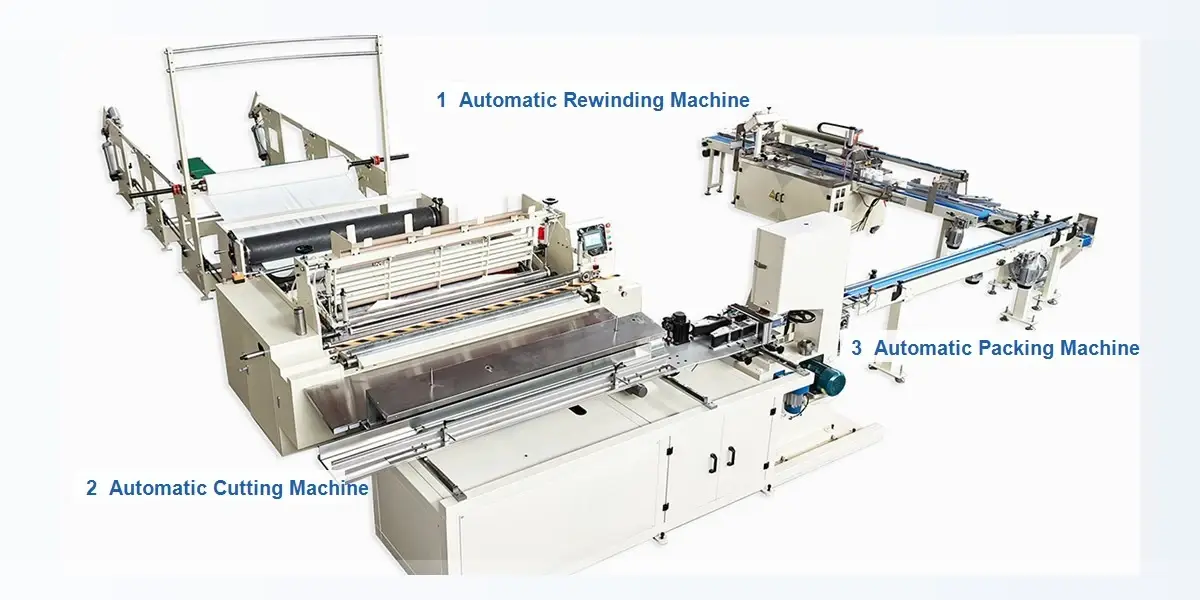
150–200 square meters of floor room are needed for the whole line, which includes the rewinder, the cutter, and the packing machine. It takes 12.5 kW to power the main rewinding unit. For steady operation, you need an industrial three-phase power source with a stable voltage.
Get Your OEM Production Line Running Right — Contact HENGYU
HENGYU makes tissue roll making machine lines for OEM converting jobs that need to change formats quickly, keep the quality of the output uniform, and keep CE/ISO records for brand client checks. We've been making tissue machinery for more than 20 years and offer a full range of converting line products. We can help with the whole process, from choosing the right equipment to installing it and training the people who will be using it. Contact our team at hengyu@hytissuemachine.com or go to hytissuemachine.com to talk to a tissue converting expert about your production needs.
References
1. TAPPI (Technical Association of the Pulp and Paper Industry). Tissue Converting Operations and Equipment Standards. 2022.
2. Paper and Packaging Board. Operational Efficiency in Paper Converting Facilities. 2021.
3. Alloca, P. & Chen, W. Industrial Automation in Tissue Manufacturing. Pulp & Paper International, 2020.
4. International Organization for Standardization. ISO 9001:2015 Quality Management Systems — Requirements. 2015.
5. European Committee for Electrotechnical Standardization. CE Marking for Industrial Machinery: Compliance and Documentation. 2019.
6. RISI (Resource Information Systems Inc.). Global Tissue Market Report: Converting Line Investment Trends. 2023.