What factors affect automatic tissue paper machine performance?
When manufacturers ask what factors affect automatic tissue paper machine performance, the answer spans multiple dimensions: machine design and automation level, raw material quality, operational maintenance discipline, and ambient environmental conditions. A high-performing automatic tissue paper machine integrates PLC-controlled systems, robust frame engineering, and multi-material compatibility to sustain consistent output. Understanding these interconnected variables helps production managers and OEM buyers avoid costly downtime, reduce per-unit costs, and build a converting line that scales reliably with market demand.
Key Dimensions Influencing Machine Design and Technology
The ceiling for everything that comes after is set by machine design. A single-layer converting line is different from a multi-layer setup in more ways than one. It affects the types of products you can offer and the high-end markets you can reach.
Fully automatic systems work better than semi-automatic and manual systems in three areas that can be measured: consistent throughput, lower reject rates, and more efficient use of labor. According to a study released by RISI Tissue World in 2023, fully automated converting lines make 18–22% fewer web breaks per shift than semi-automatic lines that work at the same speed.
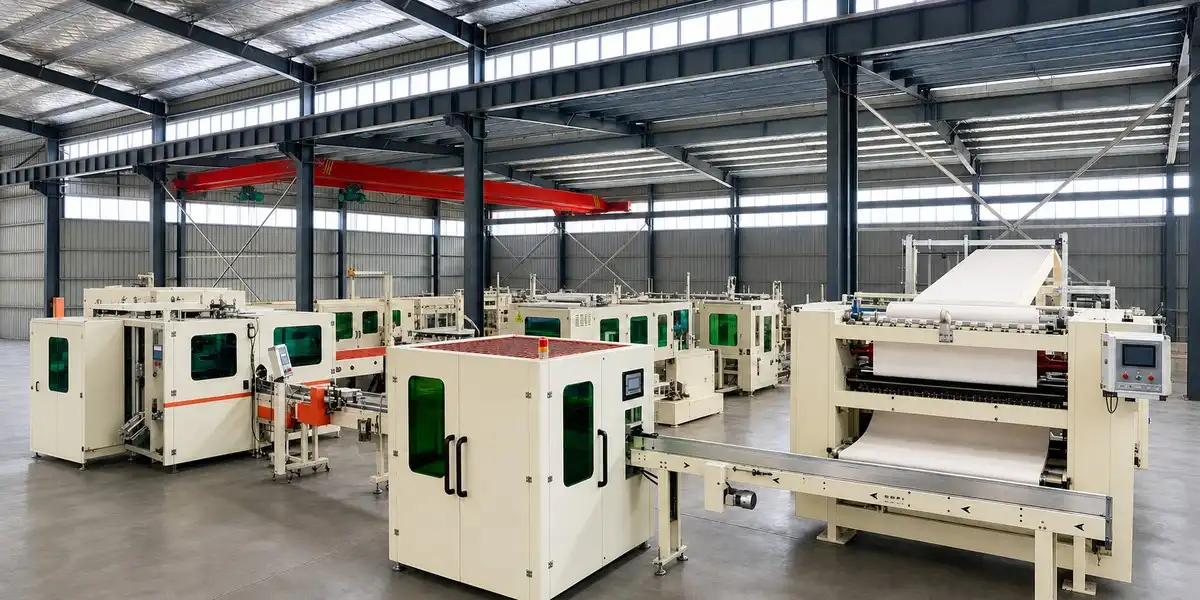
This idea is shown by the HENGYU HYF-1550. It can consistently make 100–120 m/min, and its design top speed is 130 m/min. It can make 3-ply and 4-ply face tissue from virgin pulp, bamboo pulp, and sugarcane pulp. The 1550 mm jumbo roll size can handle most store and hospitality layouts without having to change the way they are set up. Cutting tolerances on PLC-controlled folding mechanisms stay within ±0.5 mm, which is a standard that manual lines physically can't keep up with at a steady speed.
When procurement managers look at the output per investment dollar, the choice of structure—a 40 mm thick-wall steel frame vs. lighter options—has a direct effect on how stable the temperature is during 24/7 operations. Misalignment happens because of thermal expansion in frames that aren't well-designed, which lowers the accuracy of cuts and speeds up blade wear.
Operational and Maintenance Factors Affecting Performance
Scheduled Inspection and Lubrication
The three parts of an automatic tissue paper machine most likely to break down quietly are the roller bearings, the cutting blades, and the tension sensors. Lubricating the bearing blocks once a week and ultrasonic cleaning the embossing rollers once a month keep fibers from building up and changing the quality of the ply-bonding. Most unexpected stops in high-volume tissue converting settings happen because these steps are skipped.
Energy Consumption Management
Energy draw is a direct measure of performance. Depending on their layout and speed, modern converting machines with variable frequency drives (VFD) use anywhere from 15 to 45 kW. If you compare the HYF-1550's motor architecture to older motor standards, it can cut the cost per ton of finished tissue by up to 30%, according to HENGYU's confirmed output statistics. When moving between bamboo and fresh pulp, which have different tensile properties, running VFDs lets you change the power in real time.
These fields of energy and upkeep work together. When a line works within the temperature and power limits that were planned, its parts wear out much less quickly. Within five working days, HENGYU's operator training program makes production teams proficient in PLC interface navigation, format changeovers, and preventive maintenance schedules. This is because the program skips the learning curve that would otherwise lead to early operational losses.
Environmental and Material Factors Impacting Performance
The quality of the raw materials and the surroundings of the plant are two factors that machine specs alone can't account for.
One of the most underrated things that can affect performance is the amount of moisture in the pulp. When incoming jumbo rolls have moisture levels above 8%, they have more variable web tension, which causes break-detection responses and stops continuous production cycles. The HYF-1550's automatic tension-buffering system helps with this, but working with raw material suppliers to set standard moisture levels is still an important upstream task that can't be skipped.
Compared to fresh wood pulp, bamboo and sugarcane pulp are different in how they can be handled. Their fiber length ranges are different, which changes how the embossing rollers stick the plies together. The HYF-1550's tension system can handle 14–18 g/㎡ per layer for 3-ply configurations and 11.5–15 g/㎡ for 4-ply. It can handle this range of tensions without having to be mechanically reconfigured, which directly supports ESG-driven product lines for buyers in North America and Europe.
The weather and humidity of the area also have an effect on how well the glue works in embossing and how stable the finished logs' dimensions are. Southeast Asia, the Middle East, and South Asia all have high humidity temperatures, so factories in those areas should try to find HVAC systems that keep the changing area below 65% relative humidity. This stops folded tissue sheets from changing sizes, which can affect how well the packing line works with other machines further down the line.
Decision Factors When Selecting the Right Converting Line
Selecting an automatic tissue paper machine tissue conversion line involves criteria beyond specification sheets. Here are the core evaluation dimensions that experienced B2B procurement teams apply:
- Total cost of ownership (TCO): The cost of capital is one factor in the total cost of ownership (TCO). The real 5-year cost is based on how much energy is used per ton, how many workers are needed per shift, and how much money is spent each year on repair parts. When a totally automated line cuts the number of operators from 5 to 8 per shift to 2, the saves in labor are so big that the price difference is usually made up in 18 to 24 months.
- Certification and compliance: Equipment that wants to sell in controlled markets must have CE and ISO certification. Both standards are met by HENGYU machines, which helps with customs clearance and lowers the risk of responsibility for companies that want to ship.
- After-sales infrastructure: How quickly a new line starts stable production depends on how quickly it gets installation help, operator training, and parts. Because of structured video support, HENGYU's remote installation guidance makes commissioning successful for over 95% of customers, without the need for on-site technician visits by default.
- Financing and payment terms: How to pay for and finance large-format conversion lines: These require big investments in cash. Letter of credit (LC) agreements and options for phased delivery lower the risk to cash flow during the ramp-up period.
These factors collectively determine whether a converting investment delivers its projected ROI or stalls during the commissioning phase.
Case Studies and Performance Verification
The HYF-1550 was used to replace a semi-automatic line that needed seven operators per shift by a mid-sized company in Southeast Asia that makes facial tissue for hotels and stores. Within three months of opening, the facility cut the number of technicians needed for each shift to two, kept up a production rate of 110 m/min on both bamboo and virgin pulp substrates, and passed a 48-hour continuous load test without the frame structure deforming from heat.
A separate plant aimed at exporting to European store chains processed bamboo pulp to meet the ESG needs of buyers. The same machine setup handled both bamboo and sugarcane pulp. It worked in shifts, and the PLC interface made format changes possible in less than ten minutes. The plant said that its new line used 27% less energy per ton of output than its old line.
The results are similar to what the TAPPI Tissue Technology Report (2022) found: in similar production settings, converting lines with PLC integration get 15–25% better overall equipment efficiency (OEE) scores than lines that don't have PLC integration.
Conclusion
When changing tissues, automatic tissue paper machine performance is never just one thing that can happen. It comes from the place where engineering quality, maintenance discipline, standardization of materials, and environmental control meet. The HENGYU HYF-1550 meets the structure and automation needs with measured specs, including a design speed of 130 m/min, the ability to work with multiple materials, a 40 mm steel frame, and an energy range of 15 to 45 kW. The production team is still in charge of the operational and environmental factors, with help from HENGYU's training programs and lifetime technical support.
FAQ
How often should rollers and blades be inspected on a high-speed tissue converting line?
Every week, bearing blocks need to be oiled. Every two weeks, cutting blades should be run at full speed and their dimensions should be checked. Ultrasonic cleaning of embossing rollers once a month keeps fibers from building up and affecting the consistency of the ply-bonding.
What makes fully automatic systems more suitable for large-volume production than semi-automatic alternatives?
Fully automatic lines keep the output steady without any changes that depend on the operator. PLC-controlled tension and folding systems keep standards that semi-automatic machines can't match at speeds above 80 m/min. This makes a big difference in lowering the number of web breaks and rejects.
Can one machine process both bamboo pulp and virgin pulp without reconfiguration?
With its adjustable tension system and VFD torque control, the HYF-1550 can work with both surfaces. It is operationally efficient for manufacturers who serve a variety of market needs because it doesn't need to be mechanically reconfigured between material types.
What OEM customization options are available for export-oriented manufacturers?
HENGYU provides full OEM and ODM setups, which include voltage adaptation, branded HMI interfaces, and format pre-sets that are in line with the standards of certain retail markets. You can also get custom branding and localization for operating languages.
Partner With HENGYU for Your Next Automatic Tissue Paper Machine Investment
Every project that HENGYU works on is based on their more than 20 years of experience making tissue machines. The HYF-1550 automatic tissue paper machine for sale is designed for businesses that need a clear return on investment, the ability to work with a variety of materials, and durability that is approved by CE and ISO. You can email our technical team at doris@hytissuemachine.com or go to hytissuemachine.com to get a custom production assessment and equipment quote that fits your capacity goals.
References
1. RISI / Fisher International. Tissue World Market Report. 2023.
2. TAPPI. Tissue Technology and Converting Operations Report. 2022.
3. PricewaterhouseCoopers. FMCG Manufacturing Automation and Labor Cost Analysis. 2022.
4. European Environment Agency. ESG Compliance in Consumer Goods Supply Chains. 2023.
5. McKinsey & Company. Capital Equipment ROI in Emerging Market Manufacturing. 2022.
6. Food and Agriculture Organization of the United Nations (FAO). Non-Wood Fiber Utilization in Paper Manufacturing. 2021.
_1787294187070.webp)
_1784082301486.webp)