How to Choose the Right Toilet Paper Packaging Machine
To choose the right toilet paper packaging machine, start with your pack formats, then match them to realistic output, bag material, factory utilities, and supplier support. I recommend listing every roll count, pack size, and sales channel you serve before you compare models. A machine that handles 2 to 18 rolls, single and double layers, and vertical or horizontal packing can cover retail, family, and wholesale packs without a second line. Below, I walk through the factors that matter most, so you can compare quotes with confidence and avoid surprises after installation.
Start With Your Production and Packaging Requirements
Match Pack Formats to Your Sales Channels
Write down all the packs you sell and the ones you want to add. Big packs are what distributors want, while most of the time, convenience stores buy small packs. For each roll, you should write down its width, height, number of rolls per pack, and whether it's shipped vertically or horizontally. Make a list of what each channel needs to show, such as how it should look on the shelf, where the barcodes should go, and how to keep exports safe. This list tells providers what size range the machine needs to work with. If you need to store more than one type of toilet paper, a flexible multi-roll toilet paper packaging machine can save room on the floor by removing several single-use packers. It's also easy to compare quotes when the list is clear.
Separate Rated Speed From Real Output
On a plaque, it says "best case speed," not "speed you get every day." It takes longer to work after small breaks, changeovers, and reloading bags. It's a good idea to keep track of total equipment efficiency (OEE) because it improves quality, performance, and availability. Total productive maintenance was something that Seiichi Nakajima wrote about in his work. Ask each provider to give you the speed for each pack size instead of just one top number. One type, the HY-4424A, can handle six to ten packs per minute. You should test your pack sizes to see which ones can handle that the best. Then, use the proven number to plan shifts and shipping times.
Check Factory Conditions Before Requesting Quotes
Check first to see if there is space on the floor, power, and AC. It's 7800 mm long, 1600 mm wide, and 1600 mm high, and it weighs 1000 kg. Check the floor loads, door width, and ceiling height as well. It needs power at 380V, 50–60 Hz, and an air pressure of 0.5 to 0.8 MPa at 50 L/min. Early on, let the seller know if the electrical standards at your place are different. For each market, HENGYU can change how the machines are set up. Who will be in charge of the line? Ask for training and instructions in the language your team speaks. The process doesn't get held up because of these checks.
Understand Machine Types and the Packaging Process
Compare Automatic and Semi-Automatic Models
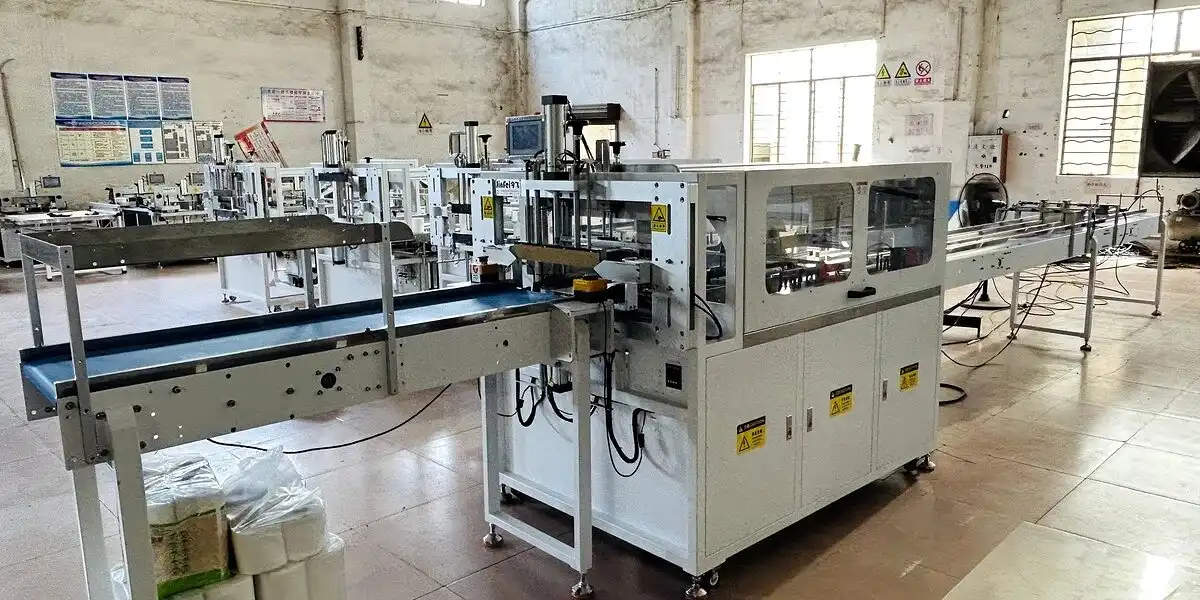
You need a person to put the rolls or bags down on semi-automatic units, so they work best for small amounts and low flow. Autonomous units can load, bag, seal, and empty materials on their own, which helps keep production steady over several shifts. When I compare the two, I ask three things: how many pack sizes do you have? How many people can you hire to pack? And how fast will your number grow? You can get rid of the bottleneck with an automatic toilet paper packaging machine if your rewinder and log saw are already too slow for packing by hand. If most of your orders are small and unique, you might still be able to use a semi-automatic model.
Follow the Bagging Process Step by Step
If you know how the process works, you can better judge a machine after reading its brochure. Rolls come in from the line upstream, line up, and group into the chosen count. The machine then seals the group in a bag that has already been made and sends the whole pack out. Some types, like film wrapping, use film to wrap the goods instead of pre-made bags. Make sure the price you get tells you which method is being used. Sensors, guides, and pneumatic parts can change the quality of the seal and how well it lines up. Ask the seller how they test each step and watch a movie of the whole process before you agree to the terms.
Choose Between Single-Layer, Double-Layer, Vertical, and Horizontal Packing
Packs with just one layer are good for small and medium-sized items. Two-level double-layer packing stacks rolls on top of each other in the HY-4424A. This feature makes the stacks more stable while they are being moved or kept. It saves room in the building and works with automatic stacking when you pack things vertically. When you pack things horizontally, they are more like how they are shown on shelves. The HY-4424A can do both of these things. Its single-layer sizes range from 240 mm x 240 mm x 120 mm to 680 mm x 360 mm x 120 mm. Its double-layer sizes range from 240 mm x 240 mm x 240 mm to 680 mm x 360 mm x 240 mm. Check these sizes against your smallest and largest packs before you decide on a model.
Evaluate Features, Materials, and Compliance
Look at Features Beyond Speed
Go over the controls, how the size changes work, and how the machine links to items further upstream. It's important to be able to change the size quickly when you go from a 4-roll market pack to a 10-roll family pack in the same shift. Ask to see an actual instance of the change you run most often. If the signal and height don't match, the machine will stop. Check how it gets rolls from your log saw or conveyor. It's also important to be able to do maintenance. The HY-4424A is easy for your maintenance staff to check because it has a simple pneumatic design and a strong frame.
Match Bag Material to the Machine
It changes how strong the seal is, how it looks, and how much trash it holds. Already-made OPP/PE combination bags are used in the HY-4424A. That way, the seller can test the bags on the machine before you place your order. Just send them sample bags with their thickness, size, and measurements. If bags aren't right, they can't seal well, get wrinkled, or make feeding hard. Make it clear from the start if your market wants recycled content or other materials. Then, ask the supplier to test those materials before they are thought to work. Verify the plastic rules in your area and the packing needs of the stores that you sell to. Putting your real bags through a test doesn't promise anything; it just shows you that it works.
Verify Safety and Compliance Documents
Ask for papers that will help you reach the people you want to reach. HENGYU machines meet both CE and ISO standards. It's also a good idea to start with ISO 12100 (machine risk assessment), IEC 60204-1 (machine electrical equipment), or ANSI/PMMI B155.1 (North American toilet paper packaging machine safety). The European Union Machinery Directive 2006/42/EC is in place. Check to see what papers come with the machine and see if it matches what the buyer needs. You should also look into any pre-shipment inspection programs that the country of destination may have. If you do this before the contract is signed, you won't have to wait or do extra work at customs.
Analyze Cost, ROI, and Supplier Support
Calculate Total Cost of Ownership
A quote doesn't tell the whole story. Add up how much it costs to ship, pay taxes, set up, use electricity, buy bags, labor, spare parts, and have the machine break down. The HY-4424A doesn't need much. It only needs 3 kW of power and 50 L/min of air to work. Take a look at these numbers and compare them to how much your present hand or semi-automatic machine costs per pack. You saved time and money, didn't have to throw away bags, got work done, and can now take orders that you couldn't before. You should not use general claims, but your own numbers. Also, you should ask each supplier to explain how they arrived at their numbers.
Use a Supplier Checklist
People who work for you should write back to you if you ask them a question. Look at the engineer's experience, how they test, their references, and whether spare parts are available. For more than 20 years, HENGYU has been making tools that make tissue. They do custom design and manufacturing (ODM/OEM) for their customers and help them with logistics around the world and technical support for life. As well as information on how the utility works, you should ask for plan drawings, guarantee terms, delivery dates, and payment terms. Get a film tour of the plant and use your own bags and rolls to test it out. You can compare scope, service, and delivery by getting at least three bids.
Plan Testing, Installation, and Maintenance
Test your rolls and bags before you ship them. Check to see if the size, output, safety features, and alarms have changed. Transport also changes the quality of the pack. ASTM D4169 tells you how to check shipping systems and cases for risks like shaking that can happen during delivery. Make sure the floor, power, air supply, and belt position are all ready before the machine gets to your site. After that, wipe down the paper dust and check the belts, sensors, air fittings, and closing parts often. Right away, fix any wrinkles, weak seals, or jams, as even small issues can cause long stops.
Make the Final Decision and Check the HY-4424A Fit
Score Each Supplier With Weighted Criteria
Give each of these things a number that shows how important it is to you: pack range, time to change sizes, quality of the package, bag fit, energy use, safety, service, ship time, total cost. Rate each thought on a scale from 1 to 5, and then increase it by the importance. The people in charge of buying things and money can look over these numbers and the thoughts that went into making them. Check to see if the machine can handle the formats that will be needed now and in the future. Also, find out if it can be expanded, since buyers often switch between different SKUs of the same product over time. The highest score shouldn't just mean the lowest price; it should also mean the best fit for your needs.
HY-4424A Technical Snapshot
A robot called HY-4424A is made by Henan Hengyu Machinery. It is used as an automatic toilet paper packaging machine. It can pack between 2 and 18 rolls per pack, and each pack can have one or two layers. It can do this 6 to 10 times per minute. It has OPP/PE composite bags that are already made and are automatically sealed and bagged. 380V, 50–60Hz, 3 kW of power, and 0.5–0.8 MPa of airflow at 50 L/min. Length: 7800 mm, width: 1600 mm, height: 1600 mm. The machine weighs 1000 kg. Firms that make a lot of different types of tissues can use this machine to pack kitchen towel rolls and other round tissues.
Core Advantages of the HY-4424A
If you want to buy, these are the main perks you need to know about.
- Flexible multi-roll range: The machine puts between 2 and 18 rolls into each bag. One line can make promotional packs with four rolls, family packs with ten rolls, and bulk bundles with twelve rolls. People who make goods can fill orders from stores, customers, and sellers without having to buy new tools for each pack style when they go from one SKU to several.
- Double-layer and dual orientation: It's better to move and store stacks that are packed in two layers. The vertical and horizontal modes are useful for stacking in a factory and putting things on shelves. This means that one machine can do the job of two different ones. This helps you save money on tools and shop space. For exporters on long shipping lines, a stable stack is important.
- Automatic, low-energy operation: The line only needs one person to watch it run because it feeds, bags, closes, and releases itself. Because of this, less work needs to be done by hand when bagging. As long as the industrial air is between 0.5 and 0.8 MPa, the system only needs 3 kW of power, and most companies that use compressed air don't have to do anything else.
These advantages target common growth problems: frequent format changes, rising labor needs, and stacking damage in transit.
Conclusion
Before you buy a toilet paper packaging machine, you should not only think about how fast it should go, but also about the types of packs you want to use, where you will sell them, and how much you will actually be making. Those needs should be met by the type of machine, the level of automation, the bagging method, and the set-ups for vertical, horizontal, single- or double-layer work. How quickly the size can be changed, how well it works with bags, the safety papers, and how much energy it needs influence how well the line works after it is set up. A source checklist, testing before shipping, and the total cost of ownership are all better ways to compare than just price. A weighted score makes it easy to decide which one to go with. It prints on both sides, can handle rolls from 2 to 18, and only uses 3 kW of power. The HY-4424A is a great choice for people who need to print on a range of pack sizes.
FAQ
1. How does a toilet paper packaging machine work?
The rolls come in from above, line up, and are grouped by the count that was chosen. The machine puts each group into a pouch that is already made. It then seals the pouch and sends the pack off. The HY-4424A can do these steps at a speed of 6 to 10 packs per minute.
2. Is an automatic model suitable for a small factory?
It is possible if you need more workers or have a lot of orders. The HY-4424A is a good choice for businesses that want to grow or for new businesses that are setting up their first automated line. Allow 7800 x 1600 x 1600 mm of space on the floor.
3. What affects the quotation?
The price depends on how many packs there are, whether they are single or double layers, how they are customized, how the equipment is joined, and how they are shipped. Send us your needs so we can give you a good quote.
4. How do I verify capacity and bag compatibility?
Test it with your own rolls and bags, and keep track of how much you get out of each pack size. These OPP/PE hybrid bags are already made for the HY-4424A, so make sure yours fit.
Request Your Toilet Paper Packaging Machine Quote From HENGYU
HENGYU has been making tools to package toilet paper packaging machines for more than 20 years. The machines they make are CE and ISO-compliant, and they can make equipment to fit your needs. They also offer technical support for life. To get more information and a quote, email hengyu@hytissuemachine.com with the size of the roll, the number of rolls per pack, your output goal, and some bag samples.
References
1. ISO 12100: Safety of Machinery – General Principles for Design – Risk Assessment and Risk Reduction, 2010
2. Directive 2006/42/EC of the European Parliament and of the Council on Machinery, 2006
3. IEC 60204-1: Safety of Machinery – Electrical Equipment of Machines, Part 1: General Requirements, 2016
4. ANSI/PMMI B155.1: Safety Requirements for Packaging Machinery and Packaging-Related Converting Machinery, 2016
5. ASTM D4169: Standard Practice for Performance Testing of Shipping Containers and Systems, 2022
6. Nakajima, Seiichi. Introduction to TPM: Total Productive Maintenance, Productivity Press, 1988