How does an automatic tissue paper machine work?
An automatic tissue paper machine converts massive jumbo rolls of tissue into finished goods without any operator manipulation. It unreels the roll under controlled tension, embosses and glues the plies, folds or rewinds the sheet, cuts it to length, counts it, and sends it to packing. A PLC and servo motors are used together at every step to keep size, count, and look the same. Below we describe each stage, the key pieces, the raw materials, and how to appraise a machine before you purchase.
What Is an Automatic Tissue Paper Machine?
Converting Versus Paper-Making
A converting machine is a machine that constantly produces toilet paper. These large rolls, dubbed "parent rolls," may be made into kitchen towels, toilet paper, face tissue, or paper towels. There is one machine that is odd, however. It manufactures base paper out of waste. First of all, a lot of individuals purchase parent rolls and then fold, cut, and box them. Each machine will need different skills, money, and space to operate. Some reference works, such as Smook's Handbook for Pulp & Paper Technologists, describe finishing paper as a distinct procedure from producing it.
Who Uses This Equipment
Lines are used by brands with their own labels, OEM and ODM producers, resellers, and converters when they wish to sell their products overseas. They are also used to create paper purchased by hotels and health care professionals. In the U.S., shops and wholesalers often demand all SKUs to have the same counts and to be packaged properly. It seems reasonable that a line that is motor-operated will always be built in the same manner. Hengyu claims that their all-robot system requires only two technicians to operate. A manual or semi-automatic line requires five to eight persons to operate.
Machine Types by Finished Product
When it’s done, it helps us choose the correct tools. A machine can rewind, stamp, perforate, cut, and bundle toilet paper rolls. Machines stack, fold and count sheets to create soft packs or boxes of facial tissues. Larger rolls need strong tension control from a kitchen towel machine. A napkin machine, however, can print and fold in novel ways. Buyers may choose single tools, flexible systems, or whole lines that can cartonize and palletize. Always-on machines are excellent when you want a constant quantity of work done fast. But if the tools only accomplish half the job, they’re better for young enterprises that require more independence. In this letter, we are talking about our HYF-1550 series of face tissues.
How an Automatic Tissue Paper Machine Works, Step by Step
Step 1: Unwinding and Tension Control
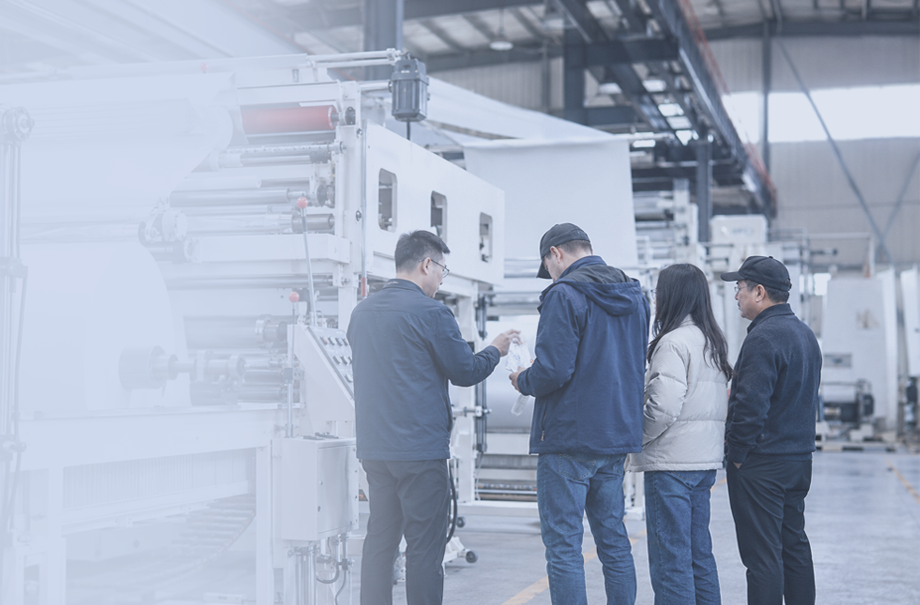
The procedure begins at the unwind stand. The 1500 mm paper stand is built for big rolls (up to Ø1500 mm), and this worker is putting one on the HYF-1550. As the machine moves the web, the drives maintain it under strain. Tissue is light and simple to rip. That’s why it’s crucial to keep the pressure on. Holes in the web are detected using infrared sensors, and the tension is automatically adjusted according to the web speed. The line stops or alters the force and prevents the paper from piling up. There are VFD drives that vary the power all the time so they can handle various kinds of paper.
Step 2: Embossing, Ply Bonding, and Folding
The plies are then pressed together at the unit. Rollers with designs on them push together three- and four-ply face tissues. When utilized in this manner, they remain together. Hengyu’s rollers may be used together with ultrasonic waves to assist in preserving constant ply bonding. Then there is a section that folds the sheet into V and N shapes. The folding devices are controlled by a PLC to preserve the cutting precision of ±0.5 mm. This ensures that stacks and packs are level.” Those two processes are what give the pack its design and fit today.
Step 3: Cutting, Counting, and Packaging
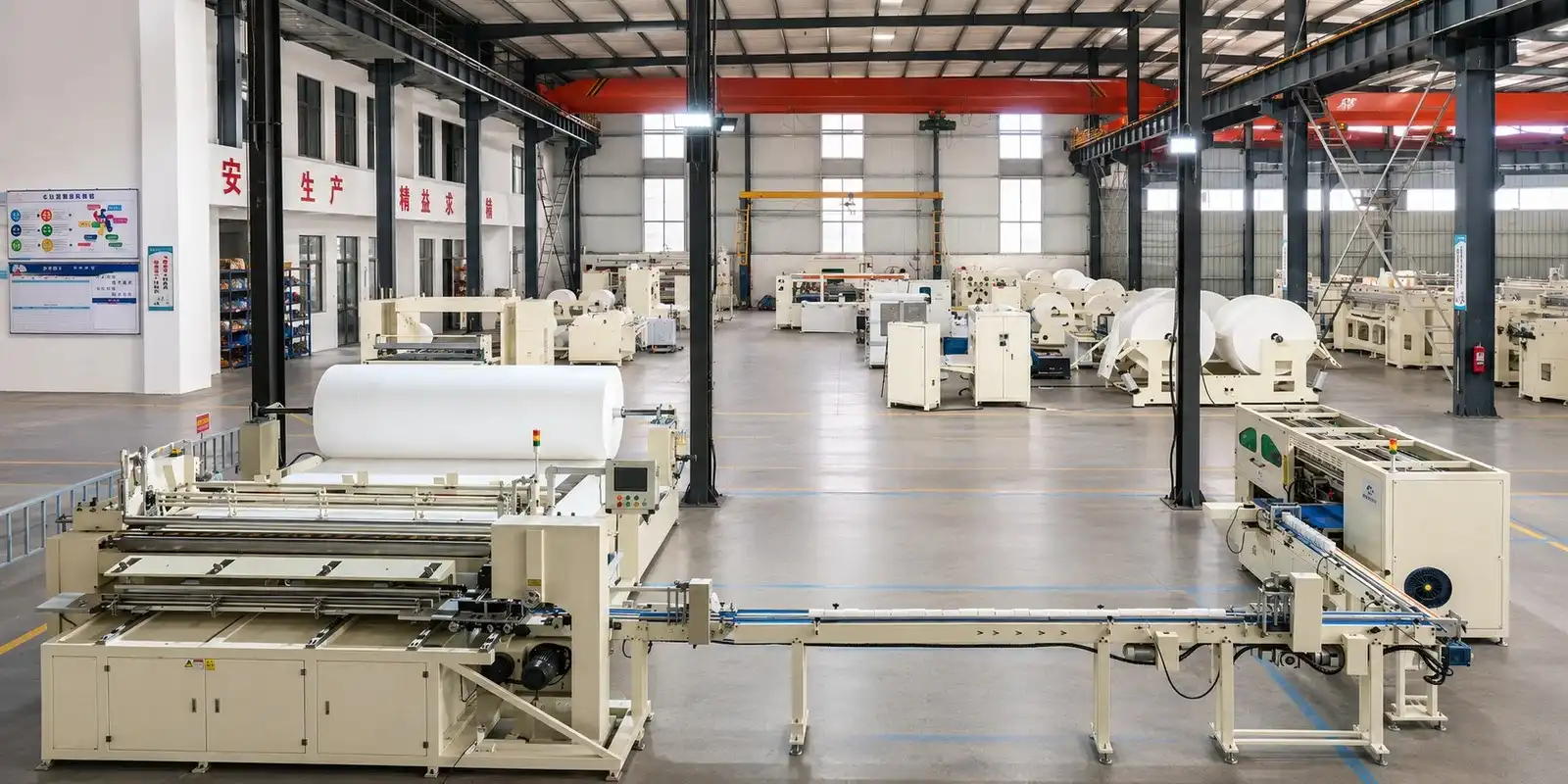
The automatic tissue paper machine folds the long web, cuts it into sheets, counts them, and after it has counted the required amount, it stacks them. The machine can produce packs of various sizes, since the height of the final log may be adjusted from 20 mm to 400 mm. Then the stacks are packed into boxes or soft packs for shipment. The packet informs you how many sheets are inside, so count them properly. Each station is connected by a PLC, so the speed, warning, and product settings are the same from the first roll to the final stack.
Main Components, Materials, and Safety
Core Components
The key sections are: the unwinding stand, the guiding system of the web and the tension control, the embossing system, the folding section, the cutting tools, the conveyors, the counting and stacking systems, and the packing modules. Your PLC and HMI tell you what speed to run, give out alarms, and define the parameters for the product. Servo motors put pieces where they need to go, precisely and rapidly. For lengthy runs and heat dissipation, the HYF-1550 is constructed with a 40 mm thick steel frame. Depending on the configuration, it can handle 15 kW up to 45 kW of electricity. You have to test it to make sure all of its elements operate together.
Raw Materials and Inputs
The tissue jumbo roll does the trick. These rolls are generally made out of either virgin wood pulp or recycled fiber. The HYF-1550 may be used with varieties of paper such as wood pulp, bamboo pulp, sugarcane pulp, and virgin pulp. The most crucial factors to know about the roll are breadth, thickness, base weight, wetness, ply, softness, tensile strength, and windability. For three-ply, the machine can do 14-18 g/㎡ per layer. It can withstand 11.5–15 g/㎡ for four layers. Tags, packaging paper, bags, boxes, and cartons they came in. Check that the roll is excellent before using it so that the web does not break and that the folds are even.
Safety and Compliance
Safety guards, emergency stops, interlocks, overload protection, fault monitors, overload protection to ensure the safety of people and machinery. Buyers may reference public standards. Tools marketed in Europe must be safe according to the EU Machinery Directive 2006/42/EC. NFPA 79 applies to the electrical equipment of industrial machinery, and IEC 60204-1 does the same for the United States. What Hengyu states is accurate. Its tools fulfill the criteria of CE and ISO. Also, U.S. residents should look up the electrical regulations in their location. Hengyu allows you to modify the voltage to suit your home’s electrical system.
HYF-1550: Specifications for High-Volume Facial Tissue
Speed and Capacity
The HYF-1550 is now able to run at 130 m/min and can continue running at 100–120 m/min. We list both since the outcome of usefulness is more essential than speed. There are 5 widths to choose from with rollers 170,175,180,190 and 200 mm wide. Width should be 1550 mm. “When the rolls are big, you don’t have to change them out as often. The fully automatic line may be installed in an industrial space of roughly 150-200 m². We’ll have a look at your layout first.
Multi-Material and Ply Handling
You may use virgin pulp for one order on the same automatic tissue paper machine and bamboo or sugarcane paper for another. When you offer items to people who desire various things, you have to be prepared to adjust with the times. Hengyu said bamboo fiber will be popular with Europe’s eco-conscious consumers, while virgin pulp would fit Middle Eastern markets. The preceding paper weighs work with 3-ply and 4-ply face tissue, but you may vary the tension mechanism. The less you have to change the material, the less likely the machine is to sit idle and waste rolls.
Format Changeovers and Labor Savings
Those working with the PLC may easily toggle between soft pack, boxed, V-fold, and N-fold configurations. This helps reduce the time between orders, which is beneficial for private label projects that have a lot of SKUs. They also have a high-grade tissue line that hotels and corporations may have imprinted to order. Log height of 20-400 mm is well adapted for tiny packs. The firm only requires two technicians each shift, so personnel may be moved to logistics and quality inspections.
Buying, Costs, and Support
Reading Specs and Output Claims
Its highest speed is different from what it produces every day. Results rely on raw material quality, order change frequency, packing format type, operator competence, and machine maintenance. Ask each supplier about the output they guarantee, test runs, samples, acceptance criteria, and waste rates. Discover the many choices of ply, embossing, installed power, compressed air demand, and footprint. ISO 9001:2015 specifies the requirements for a quality management system. While the items are being manufactured, tested, and shipped to you, ask each vendor how they ensure the goods are of a high quality.
Understanding Cost Without Surprises
The price depends on the kind of product, its speed, number of stations, degree of automation, the type of packaging required, and any extras such as printing, inspection, and remote monitoring. Get a quote including the equipment, shipping, insurance, taxes, installation, and several payment methods like EXW, FOB, CIF, DDP. It’s nice to know how to pay back significant expenditures with defined milestones. Utilities, replacement parts, downtime, and maintenance are other expenses you have to pay for. A secondhand machine may be cheaper up front, but it may be a dangerous proposition in the long term if it’s old, has parts that are hard to acquire, or has antiquated controls.
Installation, Training, and Maintenance
With video assistance and visual guides that guide them through the process step by step, over 95% of clients finish installation. Training includes format changes, PLC navigation, and preventative maintenance. Teams will be ready to produce in five days. Wipe off the dust and inspect the sensors, rollers, belts, and blades daily to maintain them in excellent condition. The pattern should be cleaned once a month, and the embossing roller bearing blocks should be greased once a week. Make sure you have spare sensors, blades, bearings, and belts ready. Hengyu also offers 24/7 language assistance and access to replacement parts.
Conclusion
In this case, an automatic tissue paper machine unwinds, embosses, folds, cuts, counts, and packs enormous rolls of tissue paper into completed goods. The operation is managed by a PLC and servo motors at each step. It is different from a paper-producing machine creating base paper from pulp. The quality of the rolls and the management of tension, including safety compliance, dictate how much is manufactured and how regularly it is made. The HYF-1550 demonstrates these principles in action: steady output of 100-120 m/min, 3-ply and 4-ply processing, support for virgin, wood, bamboo and sugarcane pulps, and format changes in less than 10 minutes. "Comparing the guaranteed output, total cost of ownership, and the supplier's installation, training, and maintenance support are the most value-added items for buyers, not just top speed."

FAQ
1. What is the difference between an automatic tissue paper machine and a tissue paper-making machine?
A converting machine turns finished jumbo rolls into toilet paper, facial tissue, napkins, or towels. A paper-making machine forms the base paper from pulp.
2. How fast is the HYF-1550?
It can go as fast as 130 m/min, but its stable production rate is 100–120 m/min. Practical output depends on roll quality, format, and maintenance.
3. Can the HYF-1550 process bamboo and sugarcane tissue?
Yes. It handles virgin pulp, wood pulp, bamboo pulp, and sugarcane pulp in 3-ply and 4-ply facial tissue, within the paper weights listed above.
Request Your HENGYU Automatic Tissue Paper Machine Proposal
Ready to plan your next tissue line? HENGYU has over 20 years of experience and offers the HYF-1550 automatic tissue paper machine with CE and ISO compliance, ODM/OEM customization, and lifetime technical service. If you want an automatic tissue paper machine manufacturer to review your project, email hengyu@hytissuemachine.com with your product list, jumbo roll specifications, and target output goals.
References
1. Smook, G.A., Handbook for Pulp & Paper Technologists, 2016
2. International Organization for Standardization, ISO 9001: Quality Management Systems – Requirements, 2015
3. European Parliament and Council, Machinery Directive 2006/42/EC, Official Journal of the European Union, 2006
4. National Fire Protection Association, NFPA 79: Electrical Standard for Industrial Machinery, 2021
5. International Electrotechnical Commission, IEC 60204-1: Safety of Machinery – Electrical Equipment of Machines, 2016
6. Encyclopaedia Britannica, Papermaking, 2024