Facial Tissue Machine Cost: Key Factors That Affect the Price
If you are planning to invest in a tissue converting line, one of the first questions you will ask is: what does a facial tissue machine actually cost? The answer depends on several variables — automation level, production speed, embossing capability, and long-term service support. Understanding these cost drivers helps you budget accurately, compare suppliers fairly, and protect your return on investment. This guide breaks down every major pricing factor so you can make a confident, well-informed procurement decision.
Understanding Facial Tissue Machine Costs: An Overview
If you want to compare prices, it helps to know about two important financial factors that every B2B buyer should keep an eye on.
CAPEX vs. OPEX: Why Both Numbers Matter
Capital spending (CAPEX) includes the cost of buying something, sending it, clearing customs, and setting it up. Operational expenditure (OPEX) includes things like labor, spare parts, energy use, and repairs over the life of the machine. A lower purchase price can easily be canceled out by higher monthly costs of running the machine if it doesn't have energy-efficient parts or if it needs to have parts replaced often.
Cost Per Unit and Lifecycle Thinking
The real measure of value is how much it costs per sheet over the life of the machine. Even though it costs more up front, a high-speed line that can print 1,000 sheets per minute has much cheaper costs per unit than a mid-range model that can print 400–500 sheets per minute. Lifecycle thinking keeps short-term saves from turning into long-term problems.
How Automation Level Shifts the Price Curve?
Semi-automatic types are cheaper to buy but need more work done each shift. Fully automatic lines with PLC control systems and HMI touch screens cost more to buy at first, but they cut down on staffing needs, prevent mistakes, and keep output quality stable over long production runs.
Core Factors Affecting Facial Tissue Machine Price
Where a machine falls on the price scale is directly related to a number of scientific factors.
Machine Type and Ply Configuration
The mechanics of single-ply facial tissue machine machines are easier, and they cost less. It costs more to build multi-ply lines because they need extra tension control steps, lamination units, and precise timing between the layers of ply. People who want to make high-end boxed or soft-pack tissues should plan ahead for the ability to use multiple layers.
Production Speed and Capacity
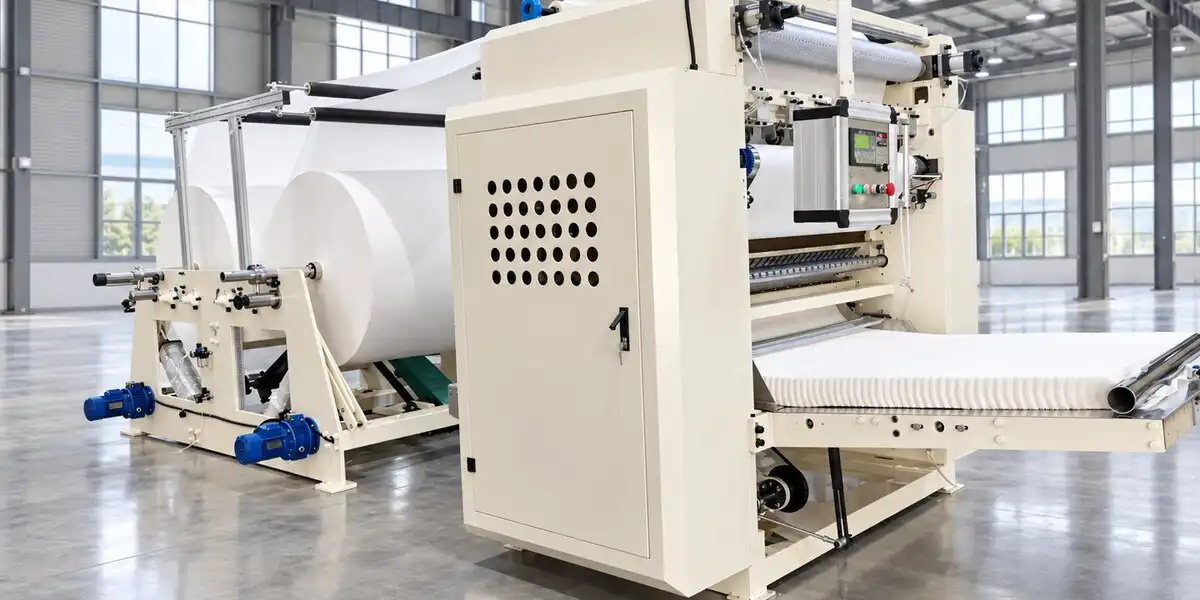
One of the most direct things that changes prices is speed. Most entry-level models can handle between 200 and 400 sheets per minute. High-quality machines like the HENGYU HYF-1050 can print up to 1,000 sheets per minute on a 1,050 mm wide jumbo roll. The bigger volume isn't just a performance number; it means a completely different mechanical and computer design, which is why the price difference is fair.
Embossing Technology and Finish Quality
Point-to-point printing works with common types of paper. The HYF-1050 uses steel-to-steel embossing, which makes the texture patterns sharper and more consistent. This makes the material feel softer and absorbent better. For private label manufacturers that supply hotel chains or high-end retail brands, steel-to-steel capability is often needed to meet client requirements, and machines that can do this are priced accordingly.
Comparison of Facial Tissue Machines: What Drives Cost Variations?
Not all tissue-converting equipment is made to the same high standard, and price differences are due to real differences in how the equipment is built.
Machine Category Differences
There are some mechanical ideas that are the same between a paper towel machine and a facial tissue folding machine. However, the folding mechanism, vacuum system needs, and sheet geometry control are very different. Towel lines are cheaper than facial tissue lines because they don't need to be as precise with their interleaving, which is usually done with a dedicated vacuum system.
Brand Reputation and Supplier Reliability
Companies that have been around for a while, have production records that can be checked, CE and ISO certifications, and clear after-sales programs set prices for their goods that represent the investments they make in them. Henan Hengyu Machinery has been in the tissue changing business for more than 20 years and stands behind its machines with a one-year guarantee on parts that aren't damaged by people and lifetime technical support. These are things that add up to real money savings over the life of a machine.
New vs. Used Equipment Trade-offs
The price of used facial tissue machine tissue converting lines may seem good, but they come with hidden costs like worn-out vacuum pump parts, old PLC software, hard-to-find spare parts, and no guarantee support. Private label makers whose clients do factory audits may find that old equipment creates compliance risks that are much greater than any savings they may have seen at first.
Maintenance, Common Issues, and Their Effect on Total Cost
A lot of buyers don't think about how much maintenance will cost. A well-designed machine with easy-to-reach parts and dependable support can make a big difference in the bottom line.
Routine Maintenance and Wear Items
Depending on the type of paper, cutting blades need to be checked every 500 to 800 work hours. The other main places that wear out are the vacuum pump filters, the polishing roller surfaces, and the tension control sensors. The 15 kW Roots vacuum pump in the HYF-1050 is designed to work continuously, which means that it has less suction-related downtime than pumps with lower specifications.
Here are the main areas of upkeep that affect how much it costs to run your business:
- Vacuum system integrity: A consistent 15 kW Roots vacuum pump maintains interleaving accuracy. Pump degradation leads directly to misfolded sheets and elevated waste rates.
- Embossing roller condition: Steel-to-steel rollers retain their pattern definition significantly longer than rubber-based alternatives, reducing regrinding frequency and associated downtime.
- Blade sharpness: Dull blades increase sheet edge defects and scrap rates. Scheduled inspection prevents cascading quality failures at high speeds.
These three maintenance areas are responsible for most of the unexpected stops in tissue conversion processes. Taking care of them ahead of time with a service program backed by the provider saves both the quality of your work and your relationships with your clients.
Operator Training and Its Financial Impact
One of the main reasons why facial tissue machine break down is because their operators aren't trained. Every function at HENGYU comes with technical training, and more than 95% of customers can finish setting up their systems without having to have someone come to their location. This arrangement keeps the costs of commissioning low and speeds up the process of reaching full output capacity.
Downtime Cost Calculation
At 80% efficiency, a line that can print 1,000 sheets per minute makes about 48,000 sheets per hour. Even an unplanned two-hour stoppage costs money because it cuts into production. Instead of relying on third-party distributors, it is more practical to buy spare parts from a manufacturer with a clear inventory and online support that is available 24/7.
How to Make the Best Cost-Effective Purchase Decision?
When making a buying choice, it's important to think about the total cost of ownership, production capacity, help quality, and purchase price.
Define Your Production Requirements First
Buyers who are very clear about their needs—such as sheet size, fold type, daily output goal, and ply count—get more accurate machine quotes and don't have to pay for features that their business doesn't need. The HYF-1050 has a finished sheet size of 200 mm (100 mm folded), and the length options can be changed. The dimensions can also be changed upon request, so it can be used for both normal and private label production runs.
Evaluate the Full Support Package
A quote for a machine that doesn't include a clear commitment to help with after the sale isn't a full offer. Check the supplier's guarantee terms, wait times for spare parts, availability of online troubleshooting, and the ability to offer video-guided operation help. These details show the difference between a trustworthy tissue machine provider and a shady one.
Direct Sourcing vs. Distributor Purchasing
When you buy directly from the manufacturer, you usually get a better deal and can talk to engineers right away. It also speeds up expert contact and makes it easier to file warranty claims. For buyers in the Middle East, Southeast Asia, and Africa, where HENGYU has set up support and shipping routes, direct buying is clearly the best way to save time and money.
Conclusion
The price of tissue converting equipment is based on real engineering options. The end price is affected by speed design, vacuum system capacity, embossing technology, and the level of support provided after the sale. When buyers look at the total cost over the whole lifecycle instead of just the purchase price, they always make better investments. The facial tissue machine HYF-1050 from HENGYU is designed for private label makers who need high-speed production, quick changeovers, and equipment that works reliably even when it's being used all the time. The numbers make it clear: if you buy the right machine for your needs and get good help, you'll see a measured return.
FAQ
What is a realistic price range for a new high-speed tissue folding machine?
Pricing varies by specification, configuration, and order volume. Industrial-grade lines capable of 1,000 sheets per minute represent a mid-to-upper tier investment within the converting equipment market. Contact suppliers directly with your production specifications to receive an accurate quotation.
How does automation level affect running costs?
Fully automatic lines require fewer operators per shift and maintain more consistent output quality, which lowers per-unit labor cost. PLC-driven systems with HMI touch screens also reduce setup time between production runs — a significant advantage for private label manufacturers handling multiple client specifications.
Can I get financing or leasing arrangements for tissue converting equipment?
Many established manufacturers offer payment term flexibility for qualified buyers. It is worth discussing installment structures or phased payment options directly with the supplier during initial technical exchanges.
How long does delivery and installation typically take?
Standard lead times for precision-assembled industrial equipment run approximately 60–90 days from order confirmation to pre-shipment testing. Installation via remote guidance typically completes within days of machine arrival on-site.
What certifications should I verify before purchasing?
CE certification for electrical safety compliance and ISO 9001 for manufacturing quality management are the two primary standards to confirm. HENGYU equipment meets both requirements for international export.
Get a Direct Quote from HENGYU — Facial Tissue Machine Supplier
HENGYU makes tissue-converting equipment for companies that need reliable support after the sale, even if the orders change quickly. The HYF-1050 face tissue machine can make up to 1,000 sheets of tissue per minute. It has a 15 kW Roots vacuum system, steel-to-steel embossing, and full PLC control. You can email our team at hengyu@hytissuemachine.com or go to hytissuemachine.com to get a quote that fits your needs right away.
References
1. TAPPI — Tissue and Nonwovens: Converting Technology and Market Trends, TAPPI Press, 2021.
2. Smithers Pira — The Future of Tissue to 2026, Smithers Pira Publishing, 2021.
3. Paper, Film & Foil Converter (PFFC) — Converting Equipment Maintenance and Cost Management, PFFC Industry Report, 2022.
4. Food and Agriculture Organization of the United Nations — Pulp and Paper Capacities: Survey 2022–2027, FAO, 2023.
5. International Finance Corporation (IFC) — Capital Expenditure Planning for Industrial Manufacturing SMEs, IFC World Bank Group, 2020.
6. RISI (now Fastmarkets RISI) — Global Tissue Industry Cost Benchmarking Report, Fastmarkets RISI, 2022.