A Guide to purchasing the best tissue paper making machine
The best way to buy a small tissue paper production machine is to match the line to your products, your real demand, and your factory floor before you compare any quotations. I start with the finished product, such as 200×200 mm facial tissue. Then I check web width, speed, embossing, cutting, floor loading, and after-sales service. A good machine runs steadily at the speed you need, accepts the paper rolls your local mills supply, and comes with clear installation and training support. This guide covers each step, from requirements to supplier checks, so you can send a precise inquiry to HENGYU.
Define Your Production Needs Before You Compare Machines
Start With Your Products and Real Demand
"What will you sell?" is the first thing I always ask traders. To fold, rewind, and cut toilet paper, drying towels, face tissue, and toilet paper rolls, you need different tools. Write down the finished size, the number of layers, the style of embossing, the core size, and the pack format. Then guess how many sales you'll get every day and every month. How much space you need will depend on how much you sell. The top speed looks great on a poster. If a plant wants to add a second or third line of facial tissue, it should first check to see how far the first line goes. When you give providers clear numbers, they can quote on the same topic, so you can compare like with like.
Document Your Factory Conditions
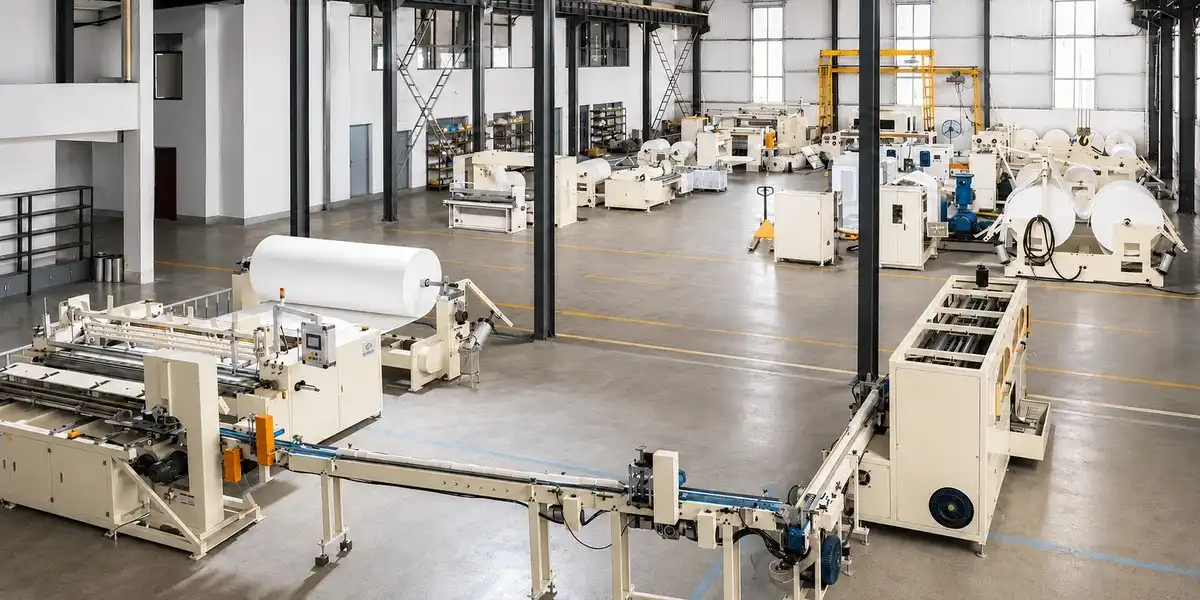
You can't do everything because of your house and your money. Find the floor space, ceiling height, door width, and the way to get from where the trucks unload to the hall where the parts are put together. Because a moving line adds a lot of weight to one spot, make sure the floor is strong enough. You should write down your power, frequency, and where the compressed air comes from. The HENGYU facial tissue line takes up 70 to 100 square meters, so it can fit in a lot of small workshops as long as they plan ahead. We need more space to store big rolls, finished goods, and repair tools. Employers must also watch out for moving machine parts, so make sure there are safe paths from the start.
Match the Configuration to Your Business Model
Each client needs a unique machine. Startups often want a simple setup with one lane or some automation and room to grow. Hotel, restaurant, and health care providers all want quality that doesn't change and can change quickly. Brands that make their own labels and OEM converters need clear instructions and embossing patterns that can be changed. Well-known plants look for stable folding and less paper waste when a slow semi-automatic machine is swapped out for a faster one. If you already have one, you should find out how the new line will share big rolls, cores, and extra parts with the old line. If you change your mind, you won't have to pay for power you can't sell.
Understand Machine Types and How the Production Process Works
Compare Roll, Folded, and Multi-Function Lines
Small tissue paper production machines fall into a few groups. There are different types. Rolled-up cooking and toilet paper can be cut, looped, embossed, and perforated. Lines for folded tissue are all about stacking, counting, and packing napkins and toilet paper. On compact multi-function lines, there is more than one item on the same base. There are also models with one or two lanes and functions that are artificial in some or all ways. When there isn't much traffic, single-lane equipment is easier to run. On the other hand, double-lane equipment helps established dealers make more money. First, pick the type that works best with the item that you want to sell the most. Then check to see if add-on units can help you get more clients.
Follow the Paper Through the Line
If you know how something works, you can find places where it is weak. When the big roll is put on the flat stand, the web guidance and tension control make sure the paper stays straight. Once that's done, the paper could be raised, folded, and cut into eye tissue-sized pieces. It is important that the raw paper is the right weight, wetness level, softness, and tensile strength at each step. Paper that is too tight or too thin can cause wrinkles, web breaks, and splits that don't stay together. This is something you should ask each service provider about, and then you should test it with your own paper. You can't learn everything you need to know from a standard sheet. A test run does.
Check Roll Size and Core Compatibility
The big roll doesn't fit the machine, so many buyers lose time. Before you place your order, make sure you know how wide the paper can go, how big the roll is, and how big the inner core is. The HENGYU face tissue change line can work with raw paper that is up to 1450 mm wide and 1100 mm tall. It comes with an inner core that is 76.2 mm, but we can change it if you need to. Compare those numbers to the rolls that the mill near you ships. So that we can set up something that works with your provider's core, let us know right away if they use a different one. With this one check, installation doesn't have to be done again.
Compare Capacity, Energy, and Total Cost
Turn Line Speed Into Real Output
It doesn't work at the same speed as it says it does. A line moving at 150 m/min moves 9,000 m of web every hour. Because of breaks for operators, changeovers, and paper breaks, the final number is less than the first one. Third, keep an eye on downtime and loss. To do this, sell speed in units like packs or boxes per shift. It's possible to slow down HENGYU's line from 50 to 150 m/min while your crew learns. When they are ready, you can speed it up. The web tension is kept steady by a 7.5 kW vacuum system, and the PLC with frequency control makes sure everything works well.
Count Energy, Labor, and Maintenance
It's not just the main motor that needs power. It's time to add the cutting unit, air blowers, vacuum system, and packed tools. The main power of HENGYU's facial tissue line is 3 kW, and it has a vacuum system with 7.5 kW and a compressor system with three air fans that can handle at least 5 kg/cm². The rotary cutting unit needs 11 kW at 380V/50Hz. Not only how much power is installed, but also how much power is normally used from each supplier. Then, keep track of how many people work each shift, how many hours are spent on repairs, and how many parts are worn out. So that no energy is lost, frequency control changes how well the motor works when the speed changes.
Build a Full Cost Picture
Quotes only show a small part of how much you'll pay. Adding up the costs of shipping, insurance, import taxes, getting the floor ready, electrical work, training, spare parts, and downtime is a good idea. Then, divide the total amount by the expected number of packs to get the cost per pack. To set your price, you need this number. Not a single bid should leave out the cutter, the packing unit, or the extra parts. Make sure that all of the bids cover the same things. Write down in the contract when the payments are due, what the warranty covers, and how the customer can accept the work. You can choose how to ship the goods once you get a price from HENGYU. These are CIF, EXW, FOB, and CFR.
HENGYU High-Speed Facial Tissue Converting Line
Key Specifications at a Glance
Henan Hengyu Machinery makes this small tissue paper production machine for professional face tissue conversion. It can handle raw paper up to 1450 mm wide and 50 to 150 m/min. Most of the time, the end size is 200x200 mm ±2 mm, but you can change it. The machine is controlled by a PLC system that lets you choose between edge and full embossing. A gas point cut and an automatic circular cut machine do the work. The cutter's round knife is 610 mm long and turns at 980 r/min. It can handle 30 to 130 mm process heights and 20 to 260 cuts per minute.
Core Advantages for Fast-Growing Plants
The most important things that happen when a plant adds a second or third line are these.
- Speed with room to scale: With speeds of 50 to 150 m/min, you can meet orders. You can go slower while the crew learns how to run the machine. You can speed up once they feel all right. You won't have to buy more line than your market needs now, and you can still grow in the future.
- Flexible product design: You can change the line to fit your market and the paper supply in your area by adding edge and full printing, changing the sizes of the tissues, and changing the 76.2 mm core. We set up the rollers for embossing so that they fit your brand's pattern. This makes your goods stand out on the shelf.
- Controlled operation: The process is managed by PLC and frequency control technology, making it easy for the user to fold and cut shapes. Three air engines provide pneumatic power, and a 7.5 kW vacuum system keeps the force steady. Train crews and keep an eye on the level of work when there is less physical work to do.
When a business grows, it often faces problems like not having enough capacity, goods that aren't flexible, and workers with varying levels of skill. These perks help fix these issues.
Footprint, Weight, and Floor Planning
Here are the facts about space and weight because they are useful. That machine changes facial tissue. It's 5150 mm long, 1400 mm wide, and 1920 mm high, and it weighs 2800 kg. The automatic rotating cutting machine is 3500 mm long, 1700 mm wide, and 2500 mm tall. It's 2400 kg heavy. Anywhere from 70 to 100 square meters is fine for a standard line. Tell your builder and forwarder these measurements. If the building is old, ask the professional to make sure the floor can hold the weight. Make sure you can unload by checking the door height and truck access as well. Let us know what your floor plan looks like, and we'll help you figure out how to set up your business.
Evaluate Suppliers, Installation, and Support
Verify Credentials and Proof
Any seller you can trust will back up what they say with proof. Request a list of parts, machine drawings, directions, ways to test, and export examples. We at Henan Hengyu Machinery have been making tissue machines for over 20 years. All of our machines are CE and ISO-approved. For sales in Europe, CE marking is connected to the Machinery Directive 2006/42/EC, and ISO 12100 tells us how to judge the risk of machine design. If you can't come to our plant, ask for a video tour of the workshop, getting things put together, and running tests. Plus, make sure the manuals come in more than one language. Let us know which working language your team prefers so we can set it up.
Plan Installation, Training, and Warranty
There's more to do than just deliver. Over 95% of our customers finish the installation with the help of engineers who watch over them on video. People who are trained will learn how to use the machine, fix it easily, and keep it in good shape. Given that each operator has a unique level of skill, you may want to record your training sessions and place simple checklists next to the machine. People who buy this line are guaranteed for one year that any parts that get broken by people will be fixed for free. For the next ten years, you can get professional help through online lessons and remote troubleshooting. Before you sign, make sure you know how long it will take to respond and who holds the parts. Also, let us know what kind of power you're using so we can help you choose the right electrical parts.
Avoid Common Mistakes and Follow a Clear Buying Process
Most problems with purchases happen when people buy too much without checking demand, compare only machine quotes, or don't check to see if the paper works with the machine. One easy step can keep you from getting them. First, write down everything you need. Second, send the same list of needs to several vendors. Third, look at sources, examples, and video proof. Fourth, agree on what needs to be done to inspect, pay, and send the papers. Fifth, write down the standard output, trash, energy use, and downtime after the machine is turned on. You should compare our features, terms of service, and sample findings to those of well-known European names. Wait a few months, and the final decision will be made then.
Conclusion
You can select the best small tissue paper production machine once you know what you need, how much you need, and where you want to put it. After that, you can use those things to compare each supplier. This guide talked about how the choice is affected by the type of machine, how it is made, the difference between the speed claimed and the output, the energy used, and the total cost. Roll and core compatibility, floor space and weight, supplier proof, compliance, training, remote installation, and warranty terms were some of the other things that were talked about. The HENGYU facial tissue changing line has a 1450 mm width, a 150 m/min speed, PLC control, and a 70–100 square meter area, so these specs are similar. There is less risk when there is a written list of requirements, quotes that cover the same amount of work, and a case study-based trial.

FAQ
1. What roll sizes does the HENGYU line accept?
It can work with raw paper that is up to 1,450 mm wide and 1,100 mm tall. The inside core can be any size you want. It is usually 76.2 mm in size.
2. How much floor space does it need?
Most lines work in an area of 70 to 100 square meters. The main machine is 5150 mm long, 1400 mm wide, and 1920 mm tall. It's 2800 kg heavy, so make sure the floor is strong first.
3. Can I change the tissue size or embossing?
Yes. It's not always 200x200 mm (±2 mm). You can change the size to something else. You can stamp just the sides or the whole thing.
4. Can I install it without an on-site engineer?
They call us and get help with the installation more than 95% of the time. We also offer training for operators and free technical help through videos for life.
5. What does the warranty cover?
If parts are broken by something other than people during the first year, they will be replaced for free. You can still get technical help after the warranty is over.
Request a Customized Small Tissue Paper Production Machine Quote from HENGYU
Would you like to add a quick hand towel line? HENGYU is a small tissue paper production machine manufacturer with more than 20 years of experience, CE and ISO certification, remote installation, and lifetime expert assistance. Our team will help you find the right setting if you send your paper specs, product size, and plant information to hengyu@hytissuemachine.com.
References
1. ISO 9001:2015 Quality Management Systems – Requirements, International Organization for Standardization, 2015
2. Directive 2006/42/EC on Machinery, European Parliament and Council of the European Union, 2006
3. ISO 12100:2010 Safety of Machinery – General Principles for Design – Risk Assessment and Risk Reduction, International Organization for Standardization, 2010
4. IEC 60204-1:2016 Safety of Machinery – Electrical Equipment of Machines – Part 1: General Requirements, International Electrotechnical Commission, 2016
5. Safeguarding Equipment and Protecting Employees from Amputations (OSHA 3170), Occupational Safety and Health Administration, 2002
6. Handbook of Paper and Board, Holik, H. (Ed.), Wiley-VCH, 2013